


Page 147 - World of Animals - Book of Sharks & Ocean Predators
P. 147
Polar bears
                               WorldMags.net


            “The polar bear’s

             huge paws act as
             oar-like paddles

             in the water for
             effi cient, energy-

             saving swimming”


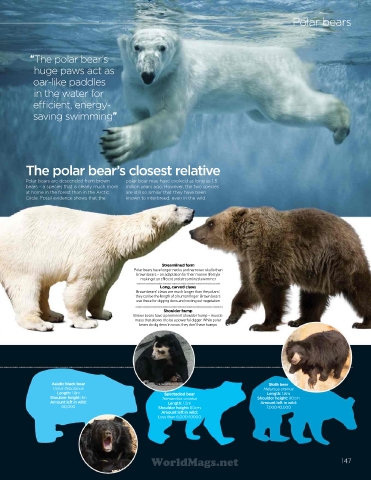
          The polar bear’s closest relative

          Polar bears are descended from brown   polar bear may have evolved as long as 1.5
          bears – a species that is clearly much more   million years ago. However, the two species
          at home in the forest than in the Arctic   are still so similar that they have been
          Circle. Fossil evidence shows that the   known to interbreed, even in the wild.


                                                          Streamlined form
                                                Polar bears have longer necks and narrower skulls than
                                                 brown bears – an adaptation for their marine lifestyle
                                                  making it an efficient and streamlined swimmer


                                                         Long, curved claws
                                                 Brown bears’ claws are much longer than the polars’;
                                                 they can be the length of a human finger. Brown bears

                                                 use these for digging dens and rooting out vegetation
                                                           Shoulder hump
                                                Brown bears have a prominent shoulder hump – muscle
                                                mass that allows it to be a powerful digger. While polar
                                                  bears do dig dens in snow, they don’t have humps


                   Asiatic black bear                                                           Sloth bear
                    Ursus thibetanus                                                          Melursus ursinus
                     Length: 1.8m                          Spectacled bear                     Length: 1.8m
                   Shoulder height: 1m                    Tremarctos ornatus               Shoulder height: 90cm
                   Amount left in wild:                     Length: 1.5m                     Amount left in wild:
                       60,000                            Shoulder height: 80cm                 7,000-10,000
                                                          Amount left in wild:
                                                         Less than 6,000-10000


                                                                                                                         147
                                                      WorldMags.net
                                                      WorldMags.net

