


Page 94 - World of Animals - Book of Sharks & Ocean Predators
P. 94
Sharks & Ocean Predators
                               WorldMags.net


        There was once a time when the oceans were thought to   mates or repelling rivals,
        be vast expanses of virtual silence, but we gradually began   but it has something to
        to realise that our planet’s water bodies were a cacophony   do with mating.”
        of aquatic noise. When biologist Roger Payne discovered   The noises that the
        the song of the humpback in the late 1960s, everything we   whales string into their
        thought we knew changed. Yet, over four decades on, we   eerie performances
        still don’t know the full story and the whales are keeping   are generated as they
        scientists guessing.                          force air through their
         Humpbacks are large whales, reaching up to 15 metres   nasal cavities “sort
        (50 feet) in length. These majestic beasts have long,   of like a bagpipe”,

        tapered bodies with elongated pectoral fins and a short   Asmutis-Silvia explains.
        dorsal fin, ending in a large fluked tail. Their knobbly heads   “They produce a low-


        have huge jaws to help with their filter-feeding method of   frequency sound and
        eating. “They’re found in all oceans, but not necessarily all   the lower the sound,
        of the time, because they’re migratory,” explains Regina   the further it will travel,
        Asmutis-Silvia, executive director of the North American   so they can conceivably
        Whale and Dolphin Conservation Society. “They tend to   communicate with other
        go to higher latitudes to feed, then to the more-temperate   whales that are tens if not
        tropical waters for breeding.”                hundreds of miles from them,”
         For whales that cruise across whole oceans every   she continues. “It’s kind of like
        year, tracking them down for study can be tricky. This is   a mobile phone – you can stay
        one reason why we don’t know much about their social   connected with your family even
        structures, or their amazing methods of communication.   when you can’t see them.” The whales’
        Like most cetaceans (the group of animals containing   keen hearing means the animals can be in
        whales and dolphins), humpbacks make grunts, whines   touch across huge expanses of ocean.
        and shrieks. However, their songs have been dubbed as   So, why do the males sing at all? “It was
        the most-complex vocalisations in the animal kingdom and   thought to happen only in the breeding area or
        are truly captivating.                        maybe the shoulder seasons,” Asmutis-Silvia continues.   ABOVE Humpback whales adopt a
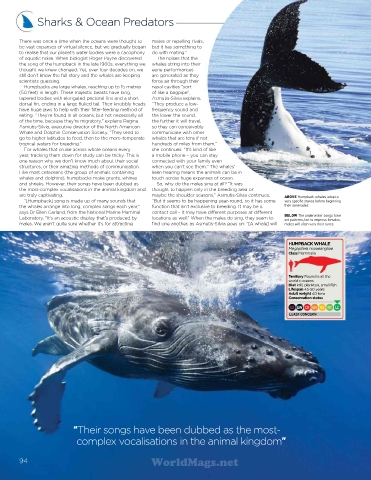
         “[Humpback] song is made up of many sounds that   “But it seems to be happening year-round, so it has some   very specifi c stance before beginning
        the whales arrange into long, complex songs each year,”   function that isn’t exclusive to breeding. It may be a   their serenades
        says Dr Ellen Garland, from the National Marine Mammal   contact call – it may have different purposes at different
                                                                                                     BELOW The underwater songs have
        Laboratory. “It’s an acoustic display that’s produced by   locations as well.” When the males do sing, they seem to   set patterns, but to impress females,
        males. We aren’t quite sure whether it’s for attracting   find one another, as Asmutis-Silvia goes on: “[A whale] will   males will o en vary their tunes


                                                                                                      HUMPBACK WHALE
                                                                                                      Megaptera novaeangliae
                                                                                                      Class Mammalia


                                                                                                      Territory Found in all the
                                                                                                      world’s oceans
                                                                                                      Diet krill, plankton, small fi sh
                                                                                                      Lifespan 45-50 years
                                                                                                      Adult weight 40 tons
                                                                                                      Conservation status


                                                                                                       LEAST CONCERN


                           “Their songs have been dubbed as the most-

                            complex vocalisations in the animal kingdom”


        94
                                                      WorldMags.net
                                                      WorldMags.net

