


Page 95 - World of Animals - Book of Sharks & Ocean Predators
P. 95
Humpback whales
                               WorldMags.net

          How do whales talk?

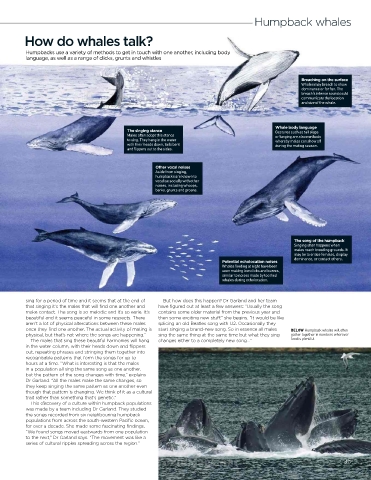
          Humpbacks use a variety of methods to get in touch with one another, including body
          language, as well as a range of clicks, grunts and whistles


                                                                                                           Breaching on the surface
                                                                                                           Whales may breach to show
                                                                                                           dominance or for fun. The
                                                                                                           breach’s intense sound could
                                                                                                           communicate the location
                                                                                                           and size of the whale.


                                                                                                  Whale body language
                                              The singing stance                                  Gestures such as tail slaps
                                              Males o en adopt this stance                        or lunging are also methods
                                              to sing. They hang in the water                     whereby males can show off
                                              with their heads down, tails bent                   during the mating season.
                                              and flippers out to the sides.

                                                        Other vocal noises
                                                        Aside from singing,
                                                        humpbacks are known to
                                                        vocalise socially with other
                                                        noises, including whoops,
                                                        barks, grunts and groans.


                                                                                                        The song of the humpback
                                                                                                        Singing o en happens when
                                                                                                        males reach breeding grounds. It
                                                                                                        may be to entice females, display
                                                                                                        dominance, or contact others.
                                                                               Potential echolocation noises
                                                                               Whales feeding at night have been
                                                                               seen making low clicks and buzzes,
                                                                               similar to noises made by toothed
                                                                               whales during echolocation.


          sing for a period of time and it seems that at the end of   But how does this happen? Dr Garland and her team
          that singing it’s the males that will find one another and   have figured out at least a few answers: “Usually the song
          make contact. The song is so melodic and it’s so eerie. It’s   contains some older material from the previous year and
          beautiful and it seems peaceful in some respects. There   then some exciting new stuff,” she begins. “It would be like
          aren’t a lot of physical altercations between these males   splicing an old Beatles song with U2. Occasionally they
          once they find one another. The actual activity of mating is   start singing a brand-new song. So in essence all males   BELOW Humpback whales will o en
          physical, but that’s not where the songs are happening.”  sing the same thing at the same time but what they sing   gather together in numbers wherever
                                                                                                       food is plentiful
            The males that sing these beautiful harmonies will hang   changes either to a completely new song…”
          in the water column, with their heads down and flippers
          out, repeating phrases and stringing them together into
          recognisable patterns that form the songs for up to
          hours at a time. “What is interesting is that the males
          in a population all sing the same song as one another,
          but the pattern of the song changes with time,” explains
          Dr Garland. “All the males make the same changes, so
          they keep singing the same pattern as one another even
          though that pattern is changing. We think of it as a cultural
          trait rather than something that’s genetic.”
            This discovery of a culture within humpback populations
          was made by a team including Dr Garland. They studied
          the songs recorded from six neighbouring humpback
          populations from across the south-western Pacific ocean,
          for over a decade. She made some fascinating findings.
          “We found songs moved eastwards from one population
          to the next,” Dr Garland says. “The movement was like a
          series of cultural ripples spreading across the region.”

                                                                                                                          95
                                                      WorldMags.net
                                                      WorldMags.net

