


Page 96 - World of Animals - Book of Sharks & Ocean Predators
P. 96
Sharks & Ocean Predators
                               WorldMags.net


         Given that the singing is most strongly (yet not exclusively) tied in   areas where there is very little food available, so it might serve a really
        with breeding amongst humpback whales, this evolution of songs may   important role for them to use up that energy in a place where they’re not

        have the benefit of impressing female whales with fresh new sounds   even sure when they’re going to get their next meal. I think that’s one of
        to be serenaded by, as well as infuse a bit of individuality for the male   the important things to remember when we’re drowning out these songs
        humpback. “In human society when new fashions appear, there are a few   with human impacts.”
        savvy people who embrace it and then everyone else quickly follows,” Dr   Unfortunately, drowning them out we sure are. These animals are highly
        Garland elaborates. “We think this male quest for song novelty is in the   sensitive, but human impacts such as seismic activity, shipping noise and
        hope of being that little bit different and more-attractive to the ladies.   sonar are having a derogatory affect on these majestic creatures. A recent
        This is then reeled in by the urge to sing the same tune, by the need to   study showed that acoustic stress from activity over 200 kilometres (124
        conform, which is the same as with humans when everyone wants to be   miles) away from the whales caused a decline in singing over a period of
        the same.”                                                months. “We’re making it harder for these animals to function,” stresses
         Whatever the whales’ reasons for composing and performing new   Asmutis-Silvia. “A recent study from the University of Vermont explained
        song material year on year, we still have so much to learn about why   how large whales are really the ecosystem engineers, as well as how their
        they vocalise in such an intricate and beautiful way. “These songs are   function and the way they work helps to fight climate change, having


        incredible, but energetically expensive,” enthuses Asmutis-Silvia. “When   positive impacts on commercially valuable fishing populations. So they’re
        you’re making a lot of noise and using up energy, you generally do it   really important – not just because we like whales, but because we’re part
        for a purpose. These songs are frequently happening in the breeding   of the ecosystem.”


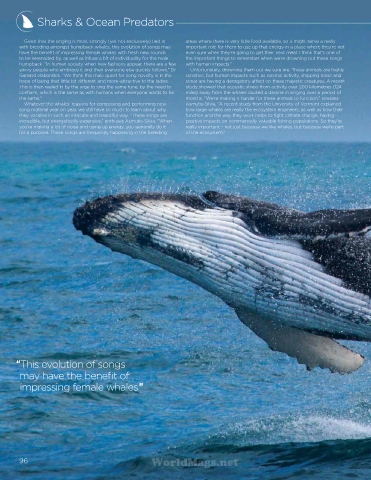
       “This evolution of songs

        may have the benefi t of
        impressing female whales ”


        96
                                                      WorldMags.net
                                                      WorldMags.net

