


Page 78 - Complete Cat Care: How To Keep Your Cat Healthy and Happy
P. 78
Wounds and burns


            Many skin wounds can be treated at home, although you will need to
            discuss them with your vet if there are complications. Burns are an
            emergency and need immediate veterinary care.

            Minor wounds                    or shock (see p.75). Small wounds   bleeding does not stop after two
            Small cuts and scrapes can be   can also become infected, so look   minutes, cover the wound with a
            treated at home. Look for bleeding,   for signs of abscess formation,    clean, dry pad (or cloth) and
            moist fur, or a scab, or the cat   such as swelling and pus.   bandage in place. For an eye
            licking an area intensely. Gently                              wound, cover the eye with a gauze
            wipe away blood and dirt using a   More serious wounds         pad and tape in place. For very
            cotton ball moistened in saline   Wounds that are bleeding profusely   heavy bleeding or a severe wound,
            solution—a teaspoon of salt stirred   need prompt veterinary attention,   apply first aid (see pp.74–5).
            into 1 pint (500 ml) of clean, warm   as do bites and scratches from other
            water. Cut away hair around the   animals (because these could   Burns
     76     wound using blunt-ended scissors.  become infected). Eye injuries also   Cats may suffer burns from fires,
             Small skin wounds can sometimes   need urgent care.           hot surfaces, scalding liquids,
                                             Call the vet before setting out. To
            occur with more extensive internal   stop bleeding, press on the wound   electrical appliances, or chemicals.
                                                                           These injuries can be very serious,
            damage. Check for heat, swelling,
      Feline emergencies  wound, and watch for signs of pain   soaked in clean, cold water. If the   need urgent veterinary attention.
                                                                           with damage to deep tissues, and
            or discolored skin around the
                                            with a gauze pad or clean cloth
                                                                             For a burn or scald, remove the
                                                                           cat from the heat source without
                                                                           endangering yourself. Flood the
                                                                           affected area with clean, cold water
                                                                           for at least 10 minutes, then cover
                                                                           it with a moist sterile dressing.
                                                                           Keep the cat warm during the
                                                                           journey to the vet.
                                                                             If your cat has been electrocuted
                                                                           (for example, by chewing through
                                                                           a power cord), turn off the power
                                                                           first, or use a wooden broom
                                                                           handle to move the power source
                                                                           away from the cat. Carry out first
                                                                           aid (see pp.74–5) and take the cat
                                                                           to the vet immediately.
                                                                             For chemical burns, call the vet
                                                                           at once and say which chemical
                                                                           is responsible. If the vet advises
                                                                           rinsing, put on rubber gloves to
                                                                           avoid contaminating yourself, and
                                                                           flush the area carefully with water.


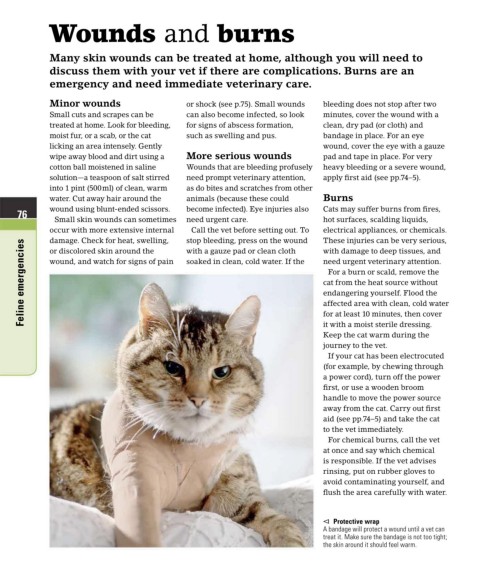
                                                                           ◁  Protective wrap
                                                                           A bandage will protect a wound until a vet can
                                                                           treat it. Make sure the bandage is not too tight;
                                                                           the skin around it should feel warm.


   US_076-077_Wounds_burns_bites_and_stings.indd   76                                                24/10/2013   15:04

