


Page 80 - Complete Cat Care: How To Keep Your Cat Healthy and Happy
P. 80
Choking and poisoning


            Cats explore their world by sniffing and tasting, pouncing and chewing.
            Although they are discerning, their inquisitiveness puts them at risk of
            swallowing dangerous items or poisonous substances.

            Choking                         with a sample of what he has   ■ Paints and solvents—cats can
            Cats can choke on a variety of   swallowed. If a cat has a toxic   swallow paint when licking it
            objects. Some objects, such as bird   substance on his coat or paws, wrap   off themselves, or breathe in
            bones, may get wedged in the    the cat in a towel so he cannot lick   dangerous fumes from paints and
            mouth; others, such as pebbles,   off any more of the substance.  solvents. Never let a cat near wet
            may block the throat (airway).                                 paint or open paint cans. Ensure
            Items such as tinsel, ribbon, string,   Dangerous chemicals    that you ventilate rooms during
            or thread can get tangled around   Some common chemicals can be   and after using paints and solvents.
            the tongue or, if swallowed, cause   lethal for cats. Keep these out of
            problems in the intestines.     reach of your cat (see pp.16–17).   Poisonous plants
     78      A choking cat will cough, drool,   ■ Antifreeze (ethylene glycol)—  Many household and garden plants
            and gag, and paw frantically at its   make sure your car does not leak   can be toxic to cats, either when
            mouth. If the airway is blocked,    antifreeze and ensure that any   eaten or when the cat brushes
            the cat will struggle to breathe
                                            containers are stored safely. For a
                                                                           against the plant and then licks
      Feline emergencies   First, wrap the cat in a towel. Hold   kidney damage, unsteadiness,   are given below; ask your vet for a
                                            cat, even a tiny amount can cause
                                                                           himself. Some common examples
            and may lose consciousness.
             Call the vet and take the cat in.
                                                                           more complete list.
                                            seizures, coma, and death.
                                                                           ■ Cordyline (common garden plant
            the top of the head with one hand,
                                            ■ Household cleaners—bleaches,
                                            detergents, fabric softeners, and
            and open the lower jaw with the
                                                                           for foliage) and Dracaena
                                            similar chemicals—can irritate the
            other. Look inside the mouth. If the
                                                                           (houseplant)—both of these plants
            object is easy to dislodge, try to
            remove it quickly with tweezers.
             If an object is blocking the airway,   cat's mouth and burn the throat.   can cause liver or kidney damage.
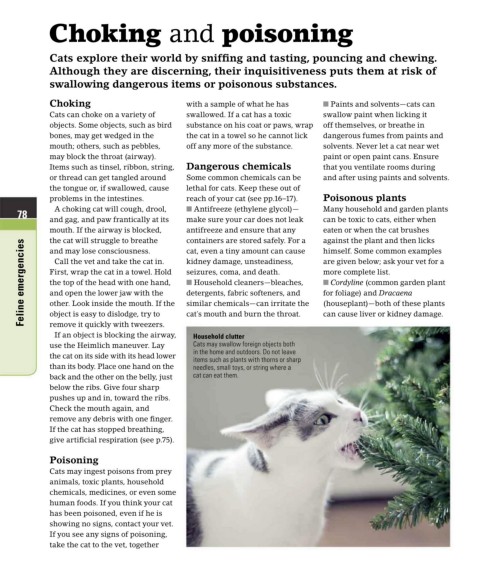
                                             Household clutter
            use the Heimlich maneuver. Lay   Cats may swallow foreign objects both
            the cat on its side with its head lower   in the home and outdoors. Do not leave
                                             items such as plants with thorns or sharp
            than its body. Place one hand on the   needles, small toys, or string where a
            back and the other on the belly, just   cat can eat them.
            below the ribs. Give four sharp
            pushes up and in, toward the ribs.
            Check the mouth again, and
            remove any debris with one finger.
            If the cat has stopped breathing,
            give artificial respiration (see p.75).
            Poisoning
            Cats may ingest poisons from prey
            animals, toxic plants, household
            chemicals, medicines, or even some
            human foods. If you think your cat
            has been poisoned, even if he is
            showing no signs, contact your vet.
            If you see any signs of poisoning,
            take the cat to the vet, together


   US_078-079_Choking_and_Poisoning.indd   78                                                        24/10/2013   15:04

