


Page 106 - (DK) Home Doctor: Providing practical advice on home treatments
P. 106
104 COMMON CONDITIONS: CHEST AND ABDOMINAL PROBLEMS

         Acute bronchitis


              Acute bronchitis is an infection of the airways in the lungs. It causes an irritating, persistent cough that
              sometimes produces thick or colored mucus (phlegm). You may also have wheezing, a fever, headache,
              and aches and pains. The illness is usually caused by a virus and often follows a cold. If you are otherwise
              healthy, it is normally not serious; you should be feeling a lot better within a few days, although the cough
              may linger for 3–4 weeks. You may be prone to bronchitis if you smoke or if you are exposed
              to pollution. People who have lung disease may have several attacks each winter.
              See also Coughing, p.102; Wheezing, p.103.


              See your doctor first
                                                                    DRUG REMEDIES
              Make an appointment to see your doctor if:
              ● You have a persistent cough and are elderly  Analgesics such as acetaminophen (see
                                                            p.177) or ibuprofen (see p.185) will reduce your
              ● You have a lung condition such as asthma,
                                                            temperature and help you feel more comfortable.
              or a heart problem such as heart failure
              ● You have difficulty breathing and chest     Cough suppressants (see p.180)
              tightness, or you are coughing up thick green,  containing dextromethorphan can help relieve a dry
              yellow, or bloodstained mucus                 cough that is keeping you awake at night. Some also
                                                                      contain sedating antihistamines (see
                                                                       p.178) to help you sleep. Don’t take
                                                                       suppressants with alcohol.
         What you can do yourself
              The following steps will help to relieve symptoms
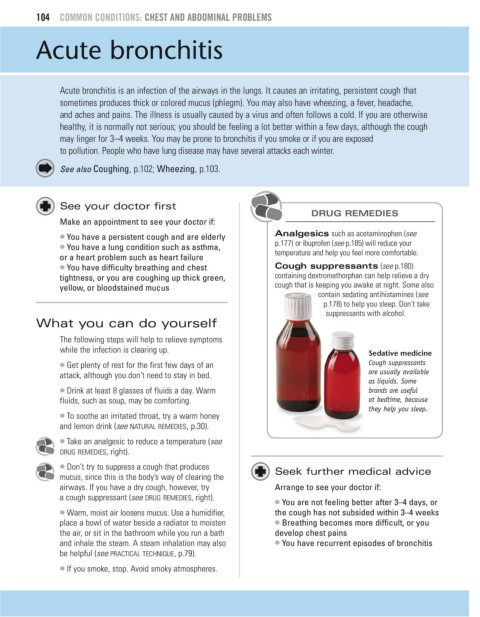
              while the infection is clearing up.                                Sedative medicine
              ● Get plenty of rest for the first few days of an                  Cough suppressants
                                                                                 are usually available
              attack, although you don’t need to stay in bed.
                                                                                 as liquids. Some
              ● Drink at least 8 glasses of fluids a day. Warm                   brands are useful
              fluids, such as soup, may be comforting.                           at bedtime, because
                                                                                 they help you sleep.
              ● To soothe an irritated throat, try a warm honey
              and lemon drink (see NATURAL REMEDIES, p.30).
              ● Take an analgesic to reduce a temperature (see
              DRUG REMEDIES, right).

              ● Don’t try to suppress a cough that produces
                                                            Seek further medical advice
              mucus, since this is the body’s way of clearing the
              airways. If you have a dry cough, however, try   Arrange to see your doctor if:
              a cough suppressant (see DRUG REMEDIES, right).
                                                            ● You are not feeling better after 3–4 days, or
              ● Warm, moist air loosens mucus. Use a humidifier,  the cough has not subsided within 3–4 weeks
              place a bowl of water beside a radiator to moisten  ● Breathing becomes more difficult, or you
              the air, or sit in the bathroom while you run a bath  develop chest pains
              and inhale the steam. A steam inhalation may also  ● You have recurrent episodes of bronchitis
              be helpful (see PRACTICAL TECHNIQUE, p.79).
              ● If you smoke, stop. Avoid smoky atmospheres.

