


Page 102 - (DK) Home Doctor: Providing practical advice on home treatments
P. 102
100  COMMON CONDITIONS: HEAD, BACK, AND LIMB PROBLEMS

         Cold fingers and toes


              It is normal for your fingers and toes to react to cold. Some people, though, feel the cold excessively, even
              if they just put their hands into a refrigerator or hold a cold drink. Poor circulation and underactivity of the
              thyroid gland can contribute to cold fingers and toes but a more common cause is Raynaud’s, in which
              tiny blood vessels in the fingers (and sometimes the toes) go into spasm, usually in response to cold. The
              fingers or toes turn white and cold, then blue. As the blood returns, they turn red and may tingle, throb, or feel
              numb or painful. Raynaud’s can also be caused by working with vibrating tools such as chainsaws, some
              prescribed drugs, and stress, or it may occur as a symptom of diseases affecting blood vessels or joints.


              See your doctor first
                                                                    PRACTICAL TIPS
              Make an appointment to see your doctor
              if your fingers or toes are exceptionally     Dressing to stay warm Put on
              sensitive to cold, to establish the cause.    several thin layers of clothing to trap heat next
                                                            to your skin; thermal underwear may help.
                                                            ● Wear a hat and warm your hands before putting
         What you can do yourself                           on gloves (or mittens, which are even warmer).
                                                            Try battery-heated gloves or hand heating aids.
              If your fingers and toes are very sensitive to cold,  ● Wear warm socks and put padding in your shoes
              try these steps to reduce the severity of symptoms.   or boots. Avoid tight-fitting footwear and clothes
                                                            because they restrict blood circulation.
              ● Try to avoid handling cold objects. Use mittens
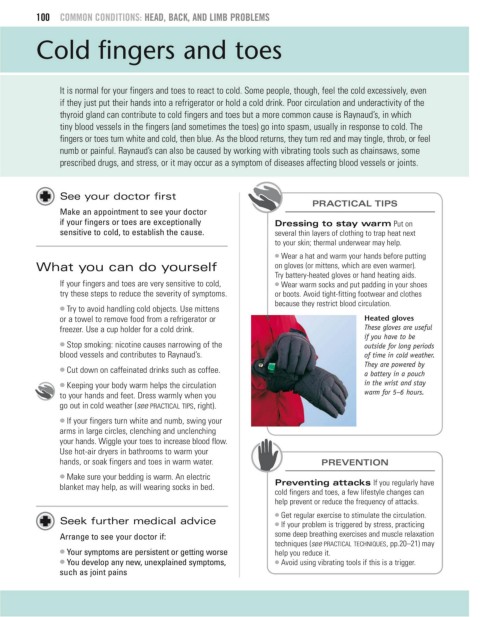
              or a towel to remove food from a refrigerator or                  Heated gloves
              freezer. Use a cup holder for a cold drink.                       These gloves are useful
                                                                                if you have to be
              ● Stop smoking: nicotine causes narrowing of the                  outside for long periods
              blood vessels and contributes to Raynaud’s.                       of time in cold weather.
                                                                                They are powered by
              ● Cut down on caffeinated drinks such as coffee.
                                                                                a battery in a pouch
              ● Keeping your body warm helps the circulation                    in the wrist and stay
              to your hands and feet. Dress warmly when you                     warm for 5–6 hours.
              go out in cold weather (see PRACTICAL TIPS, right).
              ● If your fingers turn white and numb, swing your
              arms in large circles, clenching and unclenching
              your hands. Wiggle your toes to increase blood flow.
              Use hot-air dryers in bathrooms to warm your
              hands, or soak fingers and toes in warm water.          PREVENTION
              ● Make sure your bedding is warm. An electric
                                                            Preventing attacks If you regularly have
              blanket may help, as will wearing socks in bed.
                                                            cold fingers and toes, a few lifestyle changes can
                                                            help prevent or reduce the frequency of attacks.
                                                            ● Get regular exercise to stimulate the circulation.
              Seek further medical advice                   ● If your problem is triggered by stress, practicing
              Arrange to see your doctor if:                some deep breathing exercises and muscle relaxation
                                                            techniques (see PRACTICAL TECHNIQUES, pp.20–21) may
              ● Your symptoms are persistent or getting worse  help you reduce it.
              ● You develop any new, unexplained symptoms,  ● Avoid using vibrating tools if this is a trigger.
              such as joint pains

