


Page 26 - (DK) Home Doctor: Providing practical advice on home treatments
P. 26
24   COMMON CONDITIONS: GENERAL SYMPTOMS

         Panic attacks


              Panic attacks are episodes of intense fear with unpleasant physical symptoms that usually occur without any
              outside threat being present. You may be short of breath or breathe rapidly (hyperventilate) and suffer from
              sweating, dizziness, nausea, numbness, chest pains, or palpitations. Attacks may be linked to anxiety, stress,
              depression, a phobia (such as fear of flying), or taking stimulants or drugs, but symptoms can develop for no
              apparent reason. Although the attacks usually pass quickly, fear of having them can interfere with normal life.

              See also Stress, pp.20–21; Feeling depressed, pp.22–23; Palpitations, p.105.


              See your doctor first
                                                                PRACTICAL TECHNIQUE
              Make an appointment to see your doctor to
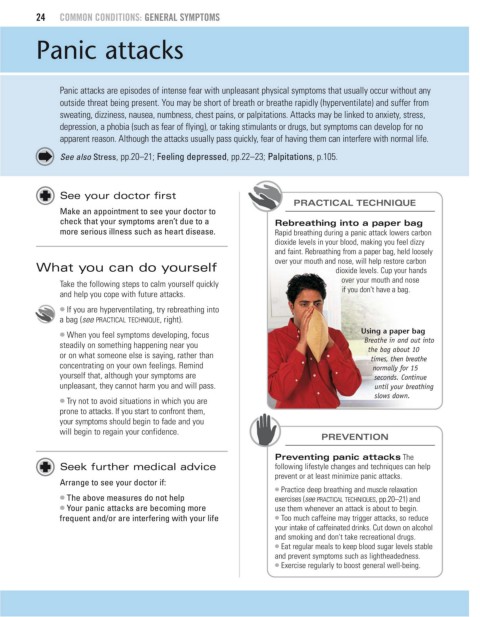
              check that your symptoms aren’t due to a      Rebreathing into a paper bag
              more serious illness such as heart disease.   Rapid breathing during a panic attack lowers carbon
                                                            dioxide levels in your blood, making you feel dizzy
                                                            and faint. Rebreathing from a paper bag, held loosely
                                                            over your mouth and nose, will help restore carbon
         What you can do yourself                                        dioxide levels. Cup your hands
                                                                           over your mouth and nose
              Take the following steps to calm yourself quickly            if you don’t have a bag.
              and help you cope with future attacks.
              ● If you are hyperventilating, try rebreathing into
              a bag (see PRACTICAL TECHNIQUE, right).
                                                                               Using a paper bag
              ● When you feel symptoms developing, focus
                                                                                Breathe in and out into
              steadily on something happening near you                          the bag about 10
              or on what someone else is saying, rather than                     times, then breathe
              concentrating on your own feelings. Remind                         normally for 15
              yourself that, although your symptoms are                           seconds. Continue
              unpleasant, they cannot harm you and will pass.                     until your breathing
                                                                                  slows down.
              ● Try not to avoid situations in which you are
              prone to attacks. If you start to confront them,
              your symptoms should begin to fade and you
              will begin to regain your confidence.
                                                                      PREVENTION
                                                            Preventing panic attacks The
              Seek further medical advice                   following lifestyle changes and techniques can help
                                                            prevent or at least minimize panic attacks.
              Arrange to see your doctor if:
                                                            ● Practice deep breathing and muscle relaxation
              ● The above measures do not help              exercises (see PRACTICAL TECHNIQUES, pp.20–21) and
              ● Your panic attacks are becoming more        use them whenever an attack is about to begin.
              frequent and/or are interfering with your life  ● Too much caffeine may trigger attacks, so reduce
                                                            your intake of caffeinated drinks. Cut down on alcohol
                                                            and smoking and don't take recreational drugs.
                                                            ● Eat regular meals to keep blood sugar levels stable
                                                            and prevent symptoms such as lightheadedness.
                                                            ● Exercise regularly to boost general well-being.

