


Page 22 - (DK) Home Doctor: Providing practical advice on home treatments
P. 22
20   COMMON CONDITIONS: GENERAL SYMPTOMS

         Stress


              When you are under stress, your muscles tighten, your heart beats faster, your breathing becomes rapid and
              shallow, and your brain becomes more alert. In small doses, stress can improve your performance in situations
              such as sports activities or work, but if excessive or prolonged it can harm your health. You may suffer from
              poor appetite, headaches, migraines, difficulty sleeping, and increased susceptibility to infections. You may
              also feel anxious, irritable, unable to concentrate, tired, sad, or depressed. Stress tends to build up when the
              normal pressures of life become too much for you, or may be triggered by an upsetting event such as a death.
              See also Fatigue, p.15; Difficulty sleeping, p.17; Feeling depressed, pp.22–23; Panic attacks, p.24.


         What you can do yourself
                                                                PRACTICAL TECHNIQUE
              People react differently to stress depending on
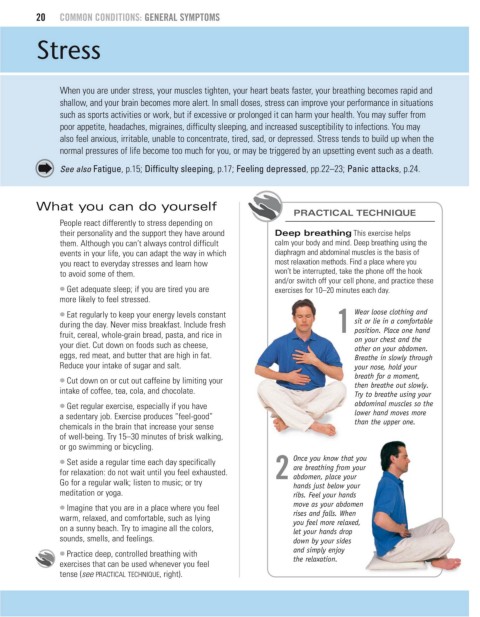
              their personality and the support they have around  Deep breathing This exercise helps
              them. Although you can’t always control difficult  calm your body and mind. Deep breathing using the
              events in your life, you can adapt the way in which  diaphragm and abdominal muscles is the basis of
              you react to everyday stresses and learn how   most relaxation methods. Find a place where you
              to avoid some of them.                        won’t be interrupted, take the phone off the hook
                                                            and/or switch off your cell phone, and practice these
              ● Get adequate sleep; if you are tired you are  exercises for 10–20 minutes each day.
              more likely to feel stressed.
              ● Eat regularly to keep your energy levels constant             Wear loose clothing and
                                                                              sit or lie in a comfortable
              during the day. Never miss breakfast. Include fresh         1 position. Place one hand
              fruit, cereal, whole-grain bread, pasta, and rice in            on your chest and the
              your diet. Cut down on foods such as cheese,                    other on your abdomen.
              eggs, red meat, and butter that are high in fat.                Breathe in slowly through
              Reduce your intake of sugar and salt.                           your nose, hold your
                                                                              breath for a moment,
              ● Cut down on or cut out caffeine by limiting your
                                                                              then breathe out slowly.
              intake of coffee, tea, cola, and chocolate.
                                                                              Try to breathe using your
              ● Get regular exercise, especially if you have                  abdominal muscles so the
                                                                              lower hand moves more
              a sedentary job. Exercise produces “feel-good”                  than the upper one.
              chemicals in the brain that increase your sense
              of well-being. Try 15–30 minutes of brisk walking,
              or go swimming or bicycling.
              ● Set aside a regular time each day specifically   Once you know that you
                                                                are breathing from your
              for relaxation: do not wait until you feel exhausted.  2 abdomen, place your
              Go for a regular walk; listen to music; or try    hands just below your
              meditation or yoga.                               ribs. Feel your hands
                                                                move as your abdomen
              ● Imagine that you are in a place where you feel
                                                                rises and falls. When
              warm, relaxed, and comfortable, such as lying     you feel more relaxed,
              on a sunny beach. Try to imagine all the colors,  let your hands drop
              sounds, smells, and feelings.                     down by your sides
              ● Practice deep, controlled breathing with        and simply enjoy
                                                                the relaxation.
              exercises that can be used whenever you feel
              tense (see PRACTICAL TECHNIQUE, right).

