


Page 51 - (DK) Home Doctor: Providing practical advice on home treatments
P. 51
COMMON CONDITIONS: SKIN, HAIR, AND NAIL PROBLEMS  49

         Dandruff


              In this harmless but sometimes embarrassing condition, excessive amounts of skin cells flake off the scalp.
              They show up as white flakes in your hair, and on your shoulders if you wear dark clothes. Your scalp may
              also be itchy and red, and your eyelids, nose, and forehead may be affected. Dandruff is usually associated
              with the growth of a yeastlike fungus on the scalp, or it can be a mild form of seborrheic dermatitis – a
              scaly, itchy rash that can also affect the eyelids. Dandruff is more common in men and may be made worse
              by stress, illness, and some hair products. Scaly, flaking skin on a baby’s scalp is known as cradle cap.
              See also Itchy eyes, p.56; Cradle cap, p.151.


         What you can do yourself
                                                                    DRUG REMEDIES
              Dandruff can usually be controlled with the
              treatments below. You may need to repeat them  Antidandruff shampoos (see p.177)
              occasionally, because the condition tends to recur.  should clear up your dandruff within a few weeks.
                                                            Follow the instructions carefully because different
              ● Use an antidandruff shampoo (see DRUG
                                                            brands have different treatment advice. Shampoos
              REMEDIES, right) and wash your hair in warm rather  may contain pyrithione zinc, selenium sulfide,
              than hot water. Massage the shampoo into your  or ketoconazole, which is particularly effective.
              scalp and make sure you leave it on long enough  Alternatively, use a shampoo that contains coal
              to work – generally about 3–5 minutes. Rinse  tar, or sulfur and salicylic acid.
              thoroughly afterward.
              ● Keep using the brand of antidandruff shampoo
              that you find works for you. If you develop
              itchiness or a rash, however, stop using the
              shampoo immediately and try switching to one
              with a different active ingredient.
              ● Don’t blow-dry your hair because it may
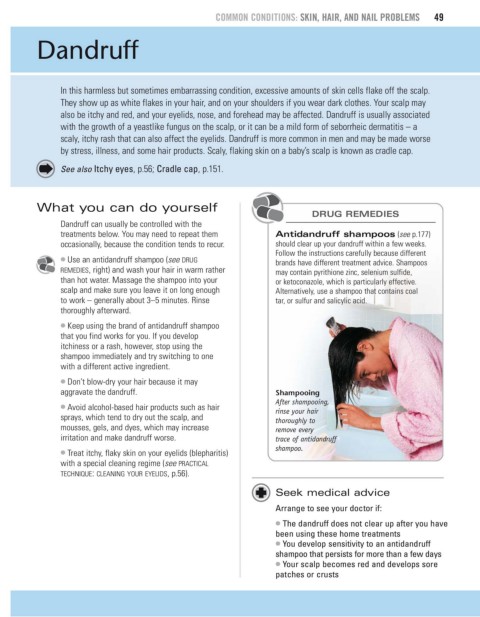
              aggravate the dandruff.                       Shampooing
                                                            After shampooing,
              ● Avoid alcohol-based hair products such as hair
                                                            rinse your hair
              sprays, which tend to dry out the scalp, and  thoroughly to
              mousses, gels, and dyes, which may increase   remove every
              irritation and make dandruff worse.           trace of antidandruff
                                                            shampoo.
              ● Treat itchy, flaky skin on your eyelids (blepharitis)
              with a special cleaning regime (see PRACTICAL
              TECHNIQUE: CLEANING YOUR EYELIDS, p.56).
                                                            Seek medical advice
                                                            Arrange to see your doctor if:
                                                            ● The dandruff does not clear up after you have
                                                            been using these home treatments
                                                            ● You develop sensitivity to an antidandruff
                                                            shampoo that persists for more than a few days
                                                            ● Your scalp becomes red and develops sore
                                                            patches or crusts

