


Page 56 - (DK) Home Doctor: Providing practical advice on home treatments
P. 56
54   COMMON CONDITIONS: SKIN, HAIR, AND NAIL PROBLEMS

         Nail biting


              Many children and adolescents chew or bite on their fingernails, but most grow out of the habit eventually.
              Some people, however, continue to bite their nails in adult life, and the habit can be hard to break. You may
              find you bite your nails inadvertently when you are bored, or as a coping mechanism during times of stress
              or anxiety. In addition to being socially unappealing, nail biting transfers germs between your hands and
              your mouth and, if you chew the skin around your nails as well, it becomes susceptible to infections. You
              may also be ashamed of the appearance of your nails, particularly if biting makes them rough, torn, or split.


              See your doctor first
                                                                    DRUG REMEDIES
              Make an appointment to see your doctor if:
                                                            Antinail-biting lotions (see p.179) have
              ● You or your child show other signs of anxiety
                                                            an extremely bitter taste that deters nibbling and
              such as hair pulling, or difficulty sleeping
                                                            acts as a reminder every time you start to bite.
                                                            They can be used for children over 5, but work with
                                                            your child, rather than forcing him or her to try one.
         What you can do yourself
              Once you or your child have decided to stop nail
              biting, take these steps to help break the habit.
              ● Sit in front of a mirror and watch yourself biting
              your nails to see how unappealing it looks.
              ● Cut your nails short, and smooth them with a fine
              emery board so there are no ragged edges to chew.
              Put adhesive bandages around the tops of your
              fingers to keep from chewing loose bits of skin.
              ● Be aware of the times when you bite your nails
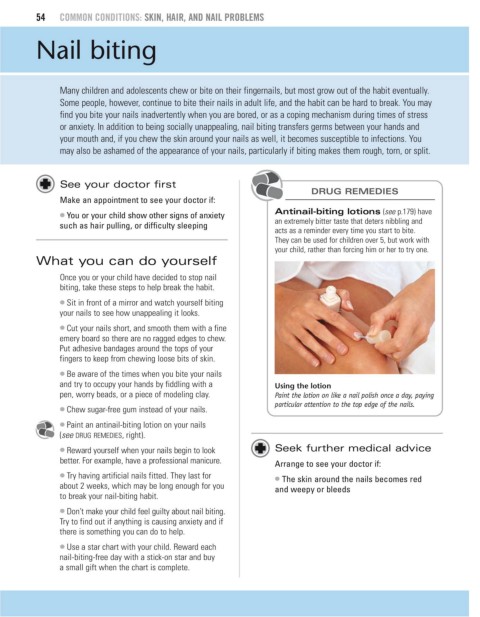
              and try to occupy your hands by fiddling with a  Using the lotion
              pen, worry beads, or a piece of modeling clay.   Paint the lotion on like a nail polish once a day, paying
                                                            particular attention to the top edge of the nails.
              ● Chew sugar-free gum instead of your nails.
              ● Paint an antinail-biting lotion on your nails
              (see DRUG REMEDIES, right).
              ● Reward yourself when your nails begin to look  Seek further medical advice
              better. For example, have a professional manicure.
                                                            Arrange to see your doctor if:
              ● Try having artificial nails fitted. They last for
                                                            ● The skin around the nails becomes red
              about 2 weeks, which may be long enough for you  and weepy or bleeds
              to break your nail-biting habit.
              ● Don’t make your child feel guilty about nail biting.
              Try to find out if anything is causing anxiety and if
              there is something you can do to help.
              ● Use a star chart with your child. Reward each
              nail-biting-free day with a stick-on star and buy
              a small gift when the chart is complete.

