


Page 62 - (DK) Home Doctor: Providing practical advice on home treatments
P. 62
60   COMMON CONDITIONS: EYE AND EAR PROBLEMS

         Contact lens problems


              The most common causes of contact lens problems are lenses
                                                                            WARNING
              that fit badly, poor lens hygiene, sensitivity to cleaning solutions,
              and dusty, windy environments. If you wear lenses for too long,  Seek immediate medical help if:
              or get a piece of grit or dirt trapped under the lens, your eyes  ● You have pain, blurred or reduced
                                                                     vision, or extreme sensitivity to light
              may become irritated, red, and watery. Sometimes a lens slips  ● Your eye is very red
              under the eyelid and needs to be retrieved and repositioned.
              See also Dry eyes, p.57.


         What you can do yourself
                                                                    DRUG REMEDIES
              The following steps will help reduce the risk
              of eye problems when you use contact lenses.  Lubricating and rewetting
                                                            eyedrops containing sodium chloride (see EYE
              ● If your eyes are irritated, take your contact
                                                            LUBRICANTS, p.182) make it easier to insert and remove
              lenses out for an hour or two to see if the   lenses. Don’t use other types of eyedrops without
              symptoms ease. If they recur when you put the  advice because some may damage your lenses.
              lenses back in, consult your optometrist or doctor.
              ● Try using lubricating eyedrops formulated for
              contact lens wearers (see DRUG REMEDIES, right).
                                                                PRACTICAL TECHNIQUE
              ● Unless you use continuous-wear lenses, don’t
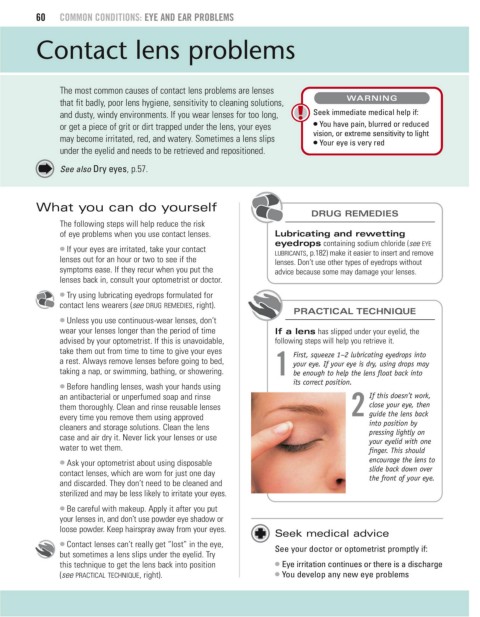
              wear your lenses longer than the period of time  If a lens has slipped under your eyelid, the
              advised by your optometrist. If this is unavoidable,  following steps will help you retrieve it.
              take them out from time to time to give your eyes  First, squeeze 1–2 lubricating eyedrops into
              a rest. Always remove lenses before going to bed,  your eye. If your eye is dry, using drops may
              taking a nap, or swimming, bathing, or showering.   1 be enough to help the lens float back into
                                                                its correct position.
              ● Before handling lenses, wash your hands using
              an antibacterial or unperfumed soap and rinse                      If this doesn’t work,
              them thoroughly. Clean and rinse reusable lenses                   close your eye, then
              every time you remove them using approved                      2 guide the lens back
                                                                                 into position by
              cleaners and storage solutions. Clean the lens
                                                                                 pressing lightly on
              case and air dry it. Never lick your lenses or use
                                                                                 your eyelid with one
              water to wet them.                                                 finger. This should
              ● Ask your optometrist about using disposable                      encourage the lens to
                                                                                 slide back down over
              contact lenses, which are worn for just one day                    the front of your eye.
              and discarded. They don’t need to be cleaned and
              sterilized and may be less likely to irritate your eyes.
              ● Be careful with makeup. Apply it after you put
              your lenses in, and don’t use powder eye shadow or
              loose powder. Keep hairspray away from your eyes.
                                                            Seek medical advice
              ● Contact lenses can’t really get “lost” in the eye,
                                                            See your doctor or optometrist promptly if:
              but sometimes a lens slips under the eyelid. Try
              this technique to get the lens back into position  ● Eye irritation continues or there is a discharge
              (see PRACTICAL TECHNIQUE, right).             ● You develop any new eye problems

