


Page 85 - (DK) Home Doctor: Providing practical advice on home treatments
P. 85
COMMON CONDITIONS: MOUTH, NOSE, AND THROAT PROBLEMS  83

         Nosebleed


              Nosebleeds are common in children, but some adults have them
              occasionally, too. Common causes include nose picking and     WARNING
              forceful nose blowing, but nosebleeds often occur for no obvious  Seek immediate medical help if:
              reason. Your nose is more likely to bleed if its delicate lining is  ● Bleeding is very severe
                                                                     ● You have hit your head or neck
              irritated because of a cold or an allergy, or if it becomes dry and  ● You are vomiting swallowed blood
              cracked due to a dry atmosphere. Although most nosebleeds are  ● You are taking aspirin or any
              little more than a temporary nuisance, bleeding is sometimes a  blood-thinning medication
              symptom of an underlying illness.


         What you can do yourself
                                                                 PRACTICAL TECHNIQUE
              Nosebleeds may look alarming but can usually be
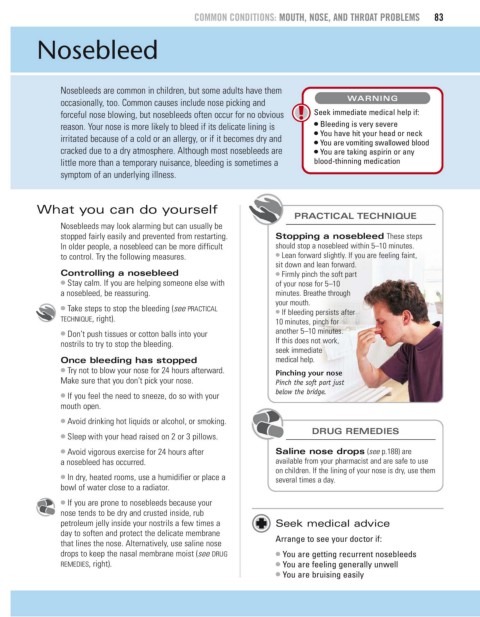
              stopped fairly easily and prevented from restarting.  Stopping a nosebleed These steps
              In older people, a nosebleed can be more difficult  should stop a nosebleed within 5–10 minutes.
              to control. Try the following measures.       ● Lean forward slightly. If you are feeling faint,
                                                            sit down and lean forward.
              Controlling a nosebleed                       ● Firmly pinch the soft part
              ● Stay calm. If you are helping someone else with  of your nose for 5–10
              a nosebleed, be reassuring.                   minutes. Breathe through
                                                            your mouth.
              ● Take steps to stop the bleeding (see PRACTICAL
                                                            ● If bleeding persists after
              TECHNIQUE, right).                            10 minutes, pinch for
              ● Don’t push tissues or cotton balls into your  another 5–10 minutes.
                                                            If this does not work,
              nostrils to try to stop the bleeding.
                                                            seek immediate
              Once bleeding has stopped                     medical help.
              ● Try not to blow your nose for 24 hours afterward.
                                                            Pinching your nose
              Make sure that you don’t pick your nose.      Pinch the soft part just
                                                            below the bridge.
              ● If you feel the need to sneeze, do so with your
              mouth open.
              ● Avoid drinking hot liquids or alcohol, or smoking.
                                                                    DRUG REMEDIES
              ● Sleep with your head raised on 2 or 3 pillows.
              ● Avoid vigorous exercise for 24 hours after   Saline nose drops (see p.188) are
              a nosebleed has occurred.                     available from your pharmacist and are safe to use
                                                            on children. If the lining of your nose is dry, use them
              ● In dry, heated rooms, use a humidifier or place a
                                                            several times a day.
              bowl of water close to a radiator.
              ● If you are prone to nosebleeds because your
              nose tends to be dry and crusted inside, rub
              petroleum jelly inside your nostrils a few times a  Seek medical advice
              day to soften and protect the delicate membrane
              that lines the nose. Alternatively, use saline nose  Arrange to see your doctor if:
              drops to keep the nasal membrane moist (see DRUG  ● You are getting recurrent nosebleeds
              REMEDIES, right).                             ● You are feeling generally unwell
                                                            ● You are bruising easily

