


Page 88 - (DK) Home Doctor: Providing practical advice on home treatments
P. 88
86   COMMON CONDITIONS: HEAD, BACK, AND LIMB PROBLEMS

         Migraine


              A migraine is an intense, throbbing headache, usually on one side of your head and often behind one eye or
              temple. You may feel nauseated or vomit, and be particularly sensitive to bright light and loud noises. A
              migraine can last for anything from a few hours to 3 days and may be so debilitating that it prevents normal
              activities. Shortly before an attack, some people have warning symptoms (known as aura), such as visual
              disturbances and an altered sense of taste and smell. Factors that can trigger migraines in susceptible people
              include stress; changes in sleep routine; certain foods and drinks; and, in women, fluctuating hormone levels.


              See your doctor first
                                                                    DRUG REMEDIES
              See your doctor to confirm that your symptoms
              are due to a migraine.                        Analgesics, such as acetaminophen (see p.177),
                                                            aspirin (see p.179), or ibuprofen (see p.185), should be
                                                            taken as soon as symptoms or aura begin to develop.
                                                            CAUTION: Children and tennagers should not use
         What you can do yourself                           aspirin before a doctor is consulted about Reye’s
                                                            syndrome, a rare but serious illness.
              Use the following treatments and self-help
              measures as soon as an attack begins.         Migraine remedies (see p.186) combine
                                                            analgesics and caffeine (which enhances the
              ● Take an analgesic at the first sign of an attack.   analgesic effect) in one pill to help relieve the
              If you feel sick or are vomiting, take a migraine  headache, nausea, and sensitivity to light and sound
              remedy (see DRUG REMEDIES, right).            associated with a migraine.
              ● If possible, lie down in a dark, quiet room with
              pillows to support your head. Try to sleep.
                                                                  NATURAL REMEDIES
              ● Sip water throughout the day, especially if you
              have been vomiting.
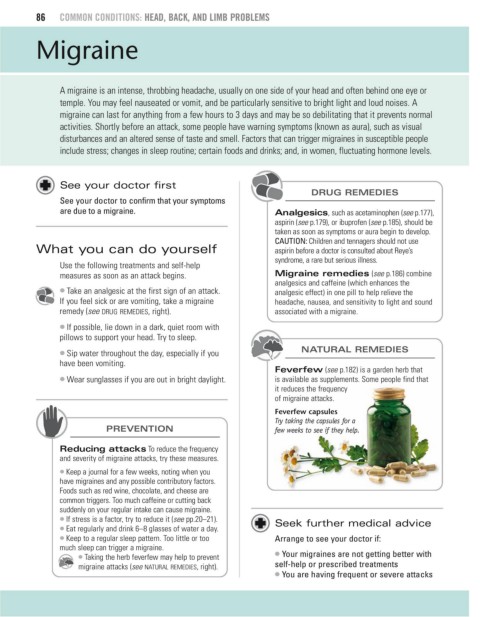
                                                            Feverfew (see p.182) is a garden herb that
              ● Wear sunglasses if you are out in bright daylight.  is available as supplements. Some people find that
                                                            it reduces the frequency
                                                            of migraine attacks.
                                                            Feverfew capsules
                                                            Try taking the capsules for a
                        PREVENTION                          few weeks to see if they help.
              Reducing attacks To reduce the frequency
              and severity of migraine attacks, try these measures.
              ● Keep a journal for a few weeks, noting when you
              have migraines and any possible contributory factors.
              Foods such as red wine, chocolate, and cheese are
              common triggers. Too much caffeine or cutting back
              suddenly on your regular intake can cause migraine.
              ● If stress is a factor, try to reduce it (see pp.20–21).
                                                            Seek further medical advice
              ● Eat regularly and drink 6–8 glasses of water a day.
              ● Keep to a regular sleep pattern. Too little or too  Arrange to see your doctor if:
              much sleep can trigger a migraine.
                                                            ● Your migraines are not getting better with
                  ● Taking the herb feverfew may help to prevent
                  migraine attacks (see NATURAL REMEDIES, right).   self-help or prescribed treatments
                                                            ● You are having frequent or severe attacks

