


Page 91 - (DK) Home Doctor: Providing practical advice on home treatments
P. 91
COMMON CONDITIONS: HEAD, BACK, AND LIMB PROBLEMS  89


         What you can do yourself continued…
                                                                    DRUG REMEDIES
              ● Rubbing the sore area with a counterirritant
              cream or gel may help soothe the pain for     Analgesics include acetaminophen (see
              a short while (see DRUG REMEDIES, right).     p.177) and ibuprofen (see p.185). Ibuprofen also
                                                            has an anti-inflammatory effect, which will reduce
              ● Holding a wrapped hot-water bottle or heating
                                                            stiffness in your back, making it easier for you to
              pad against your back may help relieve pain,  try some gentle movement.
              particularly if there is muscle spasm. You can also
              direct warm water onto the small of your back  Counterirritants (see p.181), available as
              when in the shower.                           creams, gels, or sprays, produce a tingling sensation
                                                            in the skin that soothes pain temporarily. Some
                                                            warm the area; others have a cooling effect.
              Seek further medical advice
              Arrange to see your doctor if:
                                                                PRACTICAL TECHNIQUES
              ● The back pain is getting worse or is not
              easing within 48 hours                        Standing and walking When you are
              ● You develop any of the symptoms listed      standing or walking, pull your shoulders slightly back
              in the Warning box                            and down, holding your trunk straight. Try to balance
                                                            your weight evenly over both feet.
                                                            Driving Angle the driver’s seat backward very
                                                            slightly and position it so you can reach the hand
                                                            and foot controls easily. While you are driving, check
                        PREVENTION
                                                            from time to time that your arms are relaxed and
                                                            your shoulders are not hunched.
              Avoiding back pain If you are prone
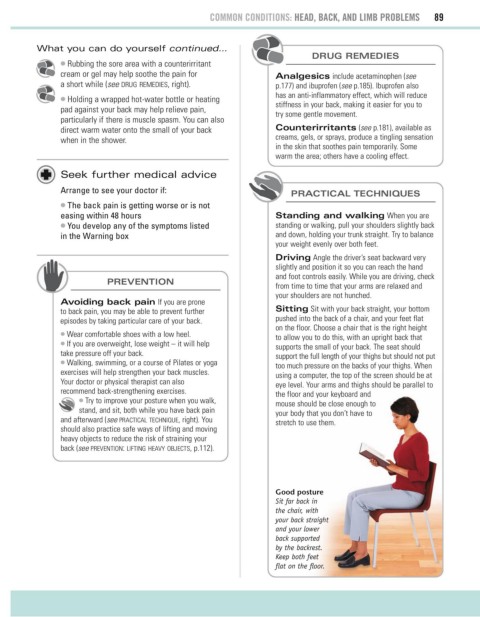
              to back pain, you may be able to prevent further  Sitting Sit with your back straight, your bottom
              episodes by taking particular care of your back.   pushed into the back of a chair, and your feet flat
                                                            on the floor. Choose a chair that is the right height
              ● Wear comfortable shoes with a low heel.
                                                            to allow you to do this, with an upright back that
              ● If you are overweight, lose weight – it will help
                                                            supports the small of your back. The seat should
              take pressure off your back.                  support the full length of your thighs but should not put
              ● Walking, swimming, or a course of Pilates or yoga
                                                            too much pressure on the backs of your thighs. When
              exercises will help strengthen your back muscles.  using a computer, the top of the screen should be at
              Your doctor or physical therapist can also    eye level. Your arms and thighs should be parallel to
              recommend back-strengthening exercises.       the floor and your keyboard and
                  ● Try to improve your posture when you walk,
                                                            mouse should be close enough to
                  stand, and sit, both while you have back pain  your body that you don’t have to
              and afterward (see PRACTICAL TECHNIQUE, right). You  stretch to use them.
              should also practice safe ways of lifting and moving
              heavy objects to reduce the risk of straining your
              back (see PREVENTION: LIFTING HEAVY OBJECTS, p.112).


                                                            Good posture
                                                            Sit far back in
                                                            the chair, with
                                                            your back straight
                                                            and your lower
                                                            back supported
                                                            by the backrest.
                                                            Keep both feet
                                                            flat on the floor.

