


Page 104 - (DK Eyewitness) Travel Guide - Rome
P. 104
102 ROME AREA B Y AREA
the flower beds in the center clear whether it was a public
follow the maze pattern of a stadium, a private track for
sunken fountain pool. exercising horses, or simply a
large garden. The alcove in the
eastern wall looks as though it
2 Cryptoporticus may have held a box from
which the emperor could have
See Visitors’ Checklist.
watched races. It is, however,
The Cryptoporticus, a series of known that the Stadium was
underground corridors, was used for foot races by the
built by Nero to connect his Ostrogothic king, Theodoric, in
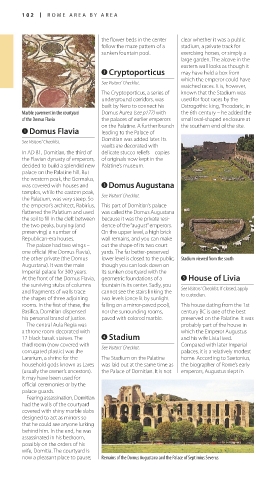
Marble pavement in the courtyard Domus Aurea (see p177) with the 6th century – he added the
of the Domus Flavia the palaces of earlier emperors small oval-shaped enclosure at
on the Palatine. A further branch the southern end of the site.
1 Domus Flavia leading to the Palace of
Domitian was added later. Its
See Visitors’ Checklist.
vaults are decorated with
In AD 81, Domitian, the third of delicate stucco reliefs – copies
the Flavian dynasty of emperors, of originals now kept in the
decided to build a splendid new Palatine’s museum.
palace on the Palatine hill. But
the western peak, the Germalus,
was covered with houses and 3 Domus Augustana
temples, while the eastern peak, See Visitors’ Checklist.
the Palatium, was very steep. So
the emperor’s architect, Rabirius, This part of Domitian’s palace
flattened the Palatium and used was called the Domus Augustana
the soil to fill in the cleft between because it was the private resi-
the two peaks, burying (and dence of the “august” emperors.
preserving) a number of On the upper level, a high brick
Republican-era houses. wall remains, and you can make
The palace had two wings – out the shape of its two court-
one official (the Domus Flavia), yards. The far better-preserved
the other private (the Domus lower level is closed to the public, Stadium viewed from the south
Augustana). It was the main though you can look down on
Imperial palace for 300 years. its sunken courtyard with the
At the front of the Domus Flavia, geometric foundations of a 5 House of Livia
the surviving stubs of columns fountain in its center. Sadly, you See Visitors’ Checklist. If closed, apply
and fragments of walls trace cannot see the stairs linking the to custodian.
the shapes of three adjoining two levels (once lit by sunlight
rooms. In the first of these, the falling on a mirror-paved pool), This house dating from the 1st
Basilica, Domitian dispensed nor the surrounding rooms, century BC is one of the best
his personal brand of justice. paved with colored marble. preserved on the Palatine. It was
The central Aula Regia was probably part of the house in
a throne room decorated with which the Emperor Augustus
12 black basalt statues. The 4 Stadium and his wife Livia lived.
third room (now covered with See Visitors’ Checklist. Compared with later Imperial
corrugated plastic) was the palaces, it is a relatively modest
Lararium, a shrine for the The Stadium on the Palatine home. According to Suetonius,
household gods known as Lares was laid out at the same time as the biographer of Rome’s early
(usually the owner’s ancestors). the Palace of Domitian. It is not emperors, Augustus slept in
It may have been used for
official ceremonies or by the
palace guards.
Fearing assassination, Domitian
had the walls of the courtyard
covered with shiny marble slabs
designed to act as mirrors so
that he could see anyone lurking
behind him. In the end, he was
assassinated in his bedroom,
possibly on the orders of his
wife, Domitia. The courtyard is
now a pleasant place to pause; Remains of the Domus Augustana and the Palace of Septimius Severus
US_102-103_EW_Rome_US.indd 102 19/04/2017 15:12

