


Page 130 - (DK Eyewitness) Travel Guide - Rome
P. 130
128 ROME AREA B Y AREA
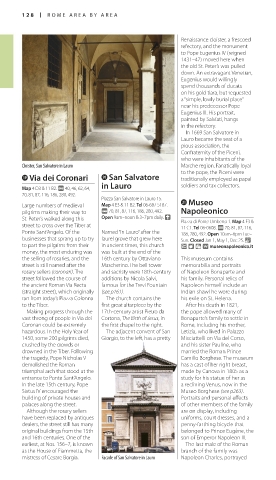
Renaissance cloister, a frescoed
refectory, and the monument
to Pope Eugenius IV (reigned
1431–47) moved here when
the old St. Peter’s was pulled
down. An extravagant Venetian,
Eugenius would willingly
spend thousands of ducats
on his gold tiara, but requested
a “simple, lowly burial place”
near his pre decessor Pope
Eugenius III. His portrait,
painted by Salviati, hangs
in the refectory.
In 1669 San Salvatore in
Lauro became the seat of a
pious association, the
Confraternity of the Piceni,
who were inhabitants of the
Cloister, San Salvatore in Lauro Marche region. Fanati cally loyal
to the pope, the Piceni were
o Via dei Coronari p San Salvatore traditionally employed as papal
in Lauro soldiers and tax collectors.
Map 4 D3 & 11 B2. @ 40, 46, 62, 64,
70, 81, 87, 116, 186, 280, 492.
Piazza San Salvatore in Lauro 15. a Museo
Large numbers of medieval Map 4 E3 & 11 B2. Tel 06-687 5187.
pilgrims making their way to @ 70, 81, 87, 116, 186, 280, 492. Napoleonico
St. Peter’s walked along this Open 9am–noon & 3–7pm daily. 5 Piazza di Ponte Umberto 1. Map 4 E3 &
street to cross over the Tiber at 11 C1. Tel 06-0608. @ 70, 81, 87, 116,
Ponte Sant’Angelo. Of the Named “in Lauro” after the 186, 280, 492. Open 10am–6pm Tue–
businesses that sprang up to try laurel grove that grew here Sun. Closed Jan 1, May 1, Dec 25. &
to part the pilgrims from their in ancient times, this church ^ 8 = ∑ museonapoleonico.it
money, the most enduring was was built at the end of the
the selling of rosaries, and the 16th century by Ottaviano This museum contains
street is still named after the Mascherino. The bell tower memorabilia and portraits
rosary sellers (coronari). The and sacristy were 18th-century of Napoleon Bonaparte and
street followed the course of additions by Nicola Salvi, his family. Personal relics of
the ancient Roman Via Recta famous for the Trevi Fountain Napoleon himself include an
(straight street), which originally (see p161). Indian shawl he wore during
ran from today’s Piazza Colonna The church contains the his exile on St. Helena.
to the Tiber. first great altarpiece by the After his death in 1821,
Making progress through the 17th-century artist Pietro da the pope allowed many of
vast throng of people in Via dei Cortona, The Birth of Jesus, in Bonaparte’s family to settle in
Coronari could be extremely the first chapel to the right. Rome, including his mother,
hazardous. In the Holy Year of The adjacent convent of San Letizia, who lived in Palazzo
1450, some 200 pilgrims died, Giorgio, to the left, has a pretty Misciattelli on Via del Corso,
crushed by the crowds or and his sister Pauline, who
drowned in the Tiber. Following married the Roman Prince
the tragedy, Pope Nicholas V Camillo Borghese. The museum
demolished the Roman has a cast of her right breast,
triumphal arch that stood at the made by Canova in 1805 as a
entrance to Ponte Sant’Angelo. study for his statue of her as
In the late 15th century, Pope a reclining Venus, now in the
Sixtus IV encouraged the Museo Borghese (see p263).
building of private houses and Portraits and personal effects
palaces along the street. of other members of the family
Although the rosary sellers are on display, including
have been replaced by antiques uniforms, court dresses, and a
dealers, the street still has many penny-farthing bicycle that
original buildings from the 15th belonged to Prince Eugène, the
and 16th centuries. One of the son of Emperor Napoleon III.
earliest, at Nos. 156–7, is known The last male of the Roman
as the House of Fiammetta, the branch of the family was
mistress of Cesare Borgia. Facade of San Salvatore in Lauro Napoleon Charles, portrayed
US_128-129_EW_Rome_US.indd 128 16/03/17 11:55 am
Eyewitness Travel LAYERS PRINTED:
Catalogue template “UK” LAYER
(Source v1.9)
Date 20th August 2012
Size 125mm x 217mm

