


Page 129 - (DK Eyewitness) Travel Guide - Rome
P. 129
PIAZZA NA VONA 127
Filippo Neri came to Rome at of the Madonna beneath the
age 18 to work as a tutor. The clock is by Pietro da Cortona,
city was undergoing a period of while on the corner of the
religious strife and an economic building is a small tabernacle
slump after the Sack of Rome to the Madonna flanked by
in 1527. There was also an angels in the style of Bernini.
outbreak of the plague. It was
left to newcomers like Neri and
Ignazio di Loyola to revive the
spiritual life of the city.
Neri formed a brotherhood
of laymen who worshipped
together and helped pilgrims
and the sick (see Santissima
Trinità dei Pellegrini p149). He
founded the Oratory as a center
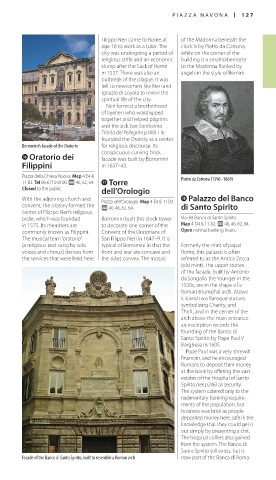
Borromini’s facade of the Oratorio for religious discourse. Its
conspicuous curving brick
y Oratorio dei facade was built by Borromini
Filippini in 1637–43.
Piazza della Chiesa Nuova. Map 4 E4 & Pietro da Cortona (1596–1669)
11 B3. Tel 066710 8100. @ 46, 62, 64. u Torre
Closed to the public. dell’Orologio
With the adjoining church and Piazza dell’Orologio. Map 4 E4 & 11 B3. i Palazzo del Banco
convent, the oratory formed the @ 40, 46, 62, 64. di Santo Spirito
center of Filippo Neri’s religious
order, which was founded Borromini built this clock tower Via del Banco di Santo Spirito.
in 1575. Its members are to decorate one corner of the Map 4 D4 & 11 A2. @ 40, 46, 62, 64.
commonly known as Filippini. Convent of the Oratorians of Open normal banking hours.
The musical term “oratorio” San Filippo Neri in 1647–9. It is
(a religious text sung by solo typical of Borromini in that the Formerly the mint of papal
voices and chorus) derives from front and rear are concave and Rome, this palazzo is often
the services that were held here. the sides convex. The mosaic referred to as the Antica Zecca
(old mint). The upper stories
of the facade, built by Antonio
da Sangallo the Younger in the
1520s, are in the shape of a
Roman triumphal arch. Above
it stand two Baroque statues
symbolizing Charity, and
Thrift, and in the center of the
arch above the main entrance
an inscription records the
founding of the Banco di
Santo Spirito by Pope Paul V
Borghese in 1605.
Pope Paul was a very shrewd
financier, and he encouraged
Romans to deposit their money
at the bank by offering the vast
estates of the Hospital of Santo
Spirito (see p246) as security.
The system catered only to the
rudimentary banking require
ments of the population, but
business was brisk as people
deposited money here, safe in the
knowledge that they could get it
out simply by presenting a chit.
The hospital coffers also gained
from the system. The Banco di
Santo Spirito still exists, but is
Facade of the Banco di Santo Spirito, built to resemble a Roman arch now part of the Banca di Roma.
US_126-127_EW_Rome_US.indd 127 15/03/17 4:20 pm

