


Page 145 - (DK Eyewitness) Travel Guide - Rome
P. 145
PIAZZA DI SP A GNA 143
p Mausoleum of s Santi Ambrogio e
Augustus Carlo al Corso
Piazza Augusto Imperatore. Map 4 F2. Via del Corso 437. Map 4 F2. Tel
Tel 06-0608. @ 81, 117, 492, 628, 926. 06-682 8101. @ 81, 117, 492, 628,
Open on special occasions only (call 926. Open 7am–7pm daily. ^
for details).
Now just a weedy mound This church belonged to the
ringed with cypresses, this was Lombard community in Rome,
once the most prestigious burial and is dedicated to two
place in Rome. Augustus had canonized bishops of Milan,
the mausoleum built in 28 BC, Lombardy’s capital. In 1471,
the year he became sole ruler, Pope Sixtus IV gave the
as a tomb for himself and his Lombards a church, which they
descendants. The circular dedicated to Sant’Ambrogio,
building was 285 ft (87 m) who died in 397. Then, in 1610,
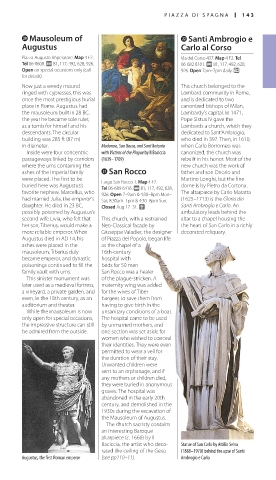
in diameter. Madonna, San Rocco, and Sant’Antonio when Carlo Borromeo was
Inside were four concentric with Victims of the Plague by Il Baciccia canonized, the church was
passageways linked by corridors (1639–1709) rebuilt in his honor. Most of the
where the urns containing the new church was the work of
ashes of the Imperial family a San Rocco father and son Onorio and
were placed. The first to be Largo San Rocco 1. Map 4 F2. Martino Longhi, but the fine
buried here was Augustus’s Tel 06-689 6416. @ 81, 117, 492, 628, dome is by Pietro da Cortona.
favorite nephew, Marcellus, who 926. Open 7–9am & 4:30–8pm Mon– The altarpiece by Carlo Maratta
had married Julia, the emperor’s Sat; 8:30am–1pm & 4:30–8pm Sun. (1625–1713) is the Gloria dei
daughter. He died in 23 BC, Closed Aug 17–31. 5 Santi Ambrogio e Carlo. An
possibly poisoned by Augustus’s ambulatory leads behind the
second wife Livia, who felt that This church, with a restrained altar to a chapel housing the
her son, Tiberius, would make a Neo-Classical facade by the heart of San Carlo in a richly
more reliable emperor. When Giuseppe Valadier, the designer decorated reliquary.
Augustus died in AD 14, his of Piazza del Popolo, began life
ashes were placed in the as the chapel of a
mausoleum, Tiberius duly 16th-century
became emperor, and dynastic hospital with
poisonings continued to fill the beds for 50 men –
family vault with urns. San Rocco was a healer
This sinister monument was of the plague-stricken. A
later used as a medieval fortress, maternity wing was added
a vineyard, a private garden, and for the wives of Tiber
even, in the 18th century, as an bargees to save them from
auditorium and theater. having to give birth in the
While the mausoleum is now unsanitary conditions of a boat.
only open for special occasions, The hospital came to be used
the impressive structure can still by unmarried mothers, and
be admired from the outside. one section was set aside for
women who wished to conceal
their identities. They were even
permitted to wear a veil for
the duration of their stay.
Unwanted children were
sent to an orphanage, and if
any mothers or children died,
they were buried in anonymous
graves. The hospital was
abandoned in the early 20th
century, and demolished in the
1930s during the excavation of
the Mausoleum of Augustus.
The church sacristy contains
an interesting Baroque
altarpiece (c. 1660) by Il
Baciccia, the artist who deco- Statue of San Carlo by Attilio Selva
rated the ceiling of the Gesù (1888–1970) behind the apse of Santi
Augustus, the first Roman emperor (see pp110–11). Ambrogio e Carlo
US_142-143_EW_Rome_US.indd 143 15/03/17 4:20 pm

