


Page 176 - (DK Eyewitness) Travel Guide - Rome
P. 176
174 ROME AREA B Y AREA
4 Santa Maria Maggiore
Of all the great Roman basilicas, Santa Maria has the most successful blend of
different architectural styles. Its colonnaded nave is part of the original 5th-century
building. The Cosmatesque marble floor and delightful Romanesque bell tower,
with its blue ceramic roundels, are medieval. The Renaissance saw a new
coffered ceiling, and the Baroque gave the church twin domes and its
imposing front and rear facades. The mosaics are Santa Maria’s most
famous feature. From the 5th
century come the biblical scenes
in the aisle and the spectacular
mosaics on the triumphal arch.
Medieval highlights include a
13th-century enthroned Christ
in the loggia.
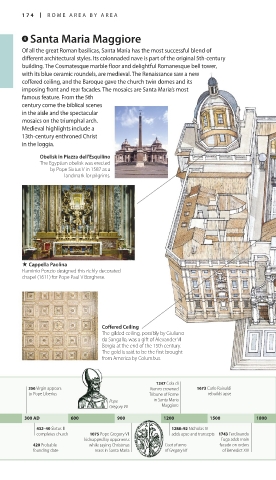
Obelisk in Piazza dell’Esquilino
The Egyptian obelisk was erected
by Pope Sixtus V in 1587 as a
landmark for pilgrims.
. Cappella Paolina
Flaminio Ponzio designed this richly decorated
chapel (1611) for Pope Paul V Borghese.
Coffered Ceiling
The gilded ceiling, possibly by Giuliano
da Sangallo, was a gift of Alexander VI
Borgia at the end of the 15th century.
The gold is said to be the first brought
from America by Columbus.
1347 Cola di
356 Virgin appears Rienzo crowned 1673 Carlo Rainaldi
to Pope Liberius Tribune of Rome rebuilds apse
Pope in Santa Maria
Gregory VII Maggiore
300 AD 600 900 1200 1500 1800
432–40 Sixtus III 1288–92 Nicholas IV
completes church 1075 Pope Gregory VII adds apse and transepts 1743 Ferdinando
kidnapped by opponents Fuga adds main
420 Probable while saying Christmas Coat of arms facade on orders
founding date mass in Santa Maria of Gregory VII of Benedict XIV
174-175_EW_Rome_US.indd 174 15/03/17 3:45 pm

