


Page 199 - (DK Eyewitness) Travel Guide - Rome
P. 199
C AR A C ALLA 197
niches with terra-cotta burial
urns. Many of the originals have
now been moved to the Vatican
Museums and copies stand in
their place.
The earliest sarcophagus
was that of Cornelius Scipio
Barbatus, consul in 298 BC, for
whom the tomb was built.
Members of his illustrious family
continued to be buried here up
to the middle of the 2nd century
BC. Excavations in the area have
revealed a columbarium similar
to that of Pomponius Hylas, a
Christian catacomb, and a three-
story house dating from the 3rd
century AD, which was built
over the Tomb of the Scipios.
e Arch of Drusus
Via di Porta San Sebastiano. Map 9 B4.
@ 218, 360.
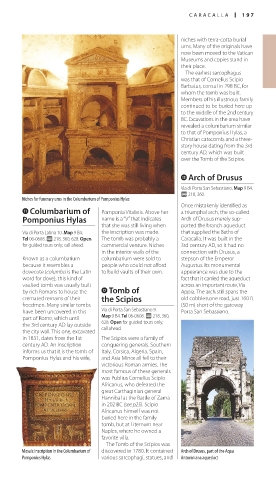
Niches for funerary urns in the Columbarium of Pomponius Hylas
Once mistakenly identified as
q Columbarium of Pomponia Vitalinis. Above her a triumphal arch, the so-called
Pomponius Hylas name is a “V” that indicates Arch of Drusus merely sup-
that she was still living when ported the branch aqueduct
Via di Porta Latina 10. Map 9 B4. the inscription was made. that supplied the Baths of
Tel 06-0608. @ 218, 360, 628. Open The tomb was probably a Caracalla. It was built in the
for guided tours only; call ahead. commercial venture. Niches 3rd century AD, so it had no
in the interior walls of the connection with Drusus, a
Known as a columbarium columbarium were sold to stepson of the Emperor
because it resembles a people who could not afford Augustus. Its monumental
dovecote (columba is the Latin to build vaults of their own. appearance was due to the
word for dove), this kind of fact that it carried the aqueduct
vaulted tomb was usually built across an important route, Via
by rich Romans to house the w Tomb of Appia. The arch still spans the
cremated remains of their the Scipios old cobblestone road, just 160 ft
freedmen. Many similar tombs (50 m) short of the gateway
have been uncovered in this Via di Porta San Sebastiano 9. Porta San Sebastiano.
part of Rome, which until Map 9 B4. Tel 06-0608. @ 218, 360,
the 3rd century AD lay outside 628. Open for guided tours only;
call ahead.
the city wall. This one, ex cavated
in 1831, dates from the 1st The Scipios were a family of
century AD. An inscription conquering generals. Southern
informs us that it is the tomb of Italy, Corsica, Algeria, Spain,
Pomponius Hylas and his wife, and Asia Minor all fell to their
victorious Roman armies. The
most famous of these generals
was Publius Cornelius Scipio
Africanus, who defeated the
great Carthaginian general
Hannibal at the Battle of Zama
in 202 BC (see p25). Scipio
Africanus himself was not
buried here in the family
tomb, but at Liternum near
Naples, where he owned a
favorite villa.
The Tomb of the Scipios was
Mosaic inscription in the Columbarium of discovered in 1780. It contained Arch of Drusus, part of the Aqua
Pomponius Hylas various sarcophagi, statues, and Antoniniana aqueduct
US_196-197_EW_Rome_US.indd 197 15/03/17 4:20 pm

