


Page 200 - (DK Eyewitness) Travel Guide - Rome
P. 200
198 ROME AREA B Y AREA
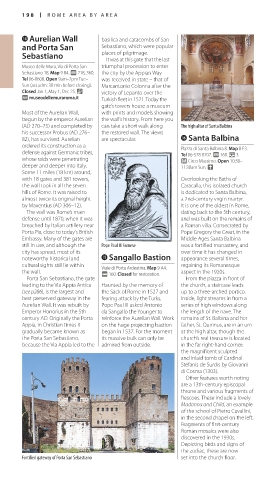
r Aurelian Wall basilica and catacombs of San
and Porta San Sebastiano, which were popular
Sebastiano places of pilgrimage.
It was at this gate that the last
Museo delle Mura, Via di Porta San triumphal procession to enter
Sebastiano 18. Map 9 B4. @ 218, 360. the city by the Appian Way
Tel 06-0608. Open 9am–2pm Tue– was received in state – that of
Sun (ast adm: 30 min before closing). Marcantonio Colonna after the
Closed Jan 1, May 1, Dec 25. & victory of Lepanto over the
∑ museodellemuraroma.it Turkish fleet in 1571. Today the
gate’s towers house a museum
Most of the Aurelian Wall, with prints and models showing
begun by the emperor Aurelian the wall’s history. From here you
(AD 270–75) and completed by can take a short walk along The high altar of Santa Balbina
his successor Probus (AD 276– the restored wall. The views
82), has survived. Aurelian are spectacular. y Santa Balbina
ordered its construction as a Piazza di Santa Balbina 8. Map 8 F3.
defense against Germanic tribes, Tel 06-578 0207. @ 160. v 3.
whose raids were penetrating q Circo Massimo. Open 10:30–
deeper and deeper into Italy. 11:30am Sun. 5
Some 11 miles (18 km) around,
with 18 gates and 381 towers, Overlooking the Baths of
the wall took in all the seven Caracalla, this isolated church
hills of Rome. It was raised to is dedicated to Santa Balbina,
almost twice its original height a 2nd-century virgin martyr.
by Maxentius (AD 306–12). It is one of the oldest in Rome,
The wall was Rome’s main dating back to the 5th century,
defense until 1870, when it was and was built on the remains of
breached by Italian artillery near a Roman villa. Consecrated by
Porta Pia, close to today’s British Pope Gregory the Great, in the
Embassy. Many of the gates are Middle Ages Santa Balbina
still in use, and although the Pope Paul III Farnese was a fortified monastery, and
city has spread, most of its over time it has changed in
noteworthy historical and t Sangallo Bastion appearance several times,
cultural sights still lie within Viale di Porta Ardeatina. Map 9 A4. regaining its Romanesque
the wall. @ 160. Closed for restoration. aspect in the 1920s.
Porta San Sebastiano, the gate From the piazza in front of
leading to the Via Appia Antica Haunted by the memory of the church, a staircase leads
(see p286), is the largest and the Sack of Rome in 1527 and up to a three-arched portico.
best-preserved gateway in the fearing attack by the Turks, Inside, light streams in from a
Aurelian Wall. It was rebuilt by Pope Paul III asked Antonio series of high windows along
Emperor Honorius in the 5th da Sangallo the Younger to the length of the nave. The
century AD. Originally the Porta reinforce the Aurelian Wall. Work remains of St. Balbina and her
Appia, in Christian times it on the huge projecting bastion father, St. Quirinus, are in an urn
gradually became known as began in 1537. For the moment at the high altar, though the
the Porta San Sebastiano, its massive bulk can only be church’s real treasure is located
because the Via Appia led to the admired from outside. in the far right-hand corner:
the magnificent sculpted
and inlaid tomb of Cardinal
Stefanis de Surdis by Giovanni
di Cosma (1303).
Other features worth noting
are a 13th-century episcopal
throne and various fragments of
frescoes. These include a lovely
Madonna and Child, an example
of the school of Pietro Cavallini,
in the second chapel on the left.
Fragments of first-century
Roman mosaics were also
discovered in the 1930s.
Depicting birds and signs of
the zodiac, these are now
Fortified gateway of Porta San Sebastiano set into the church floor.
US_198-199_EW_Rome_US.indd 198 15/03/17 4:20 pm
Eyewitness Travel LAYERS PRINTED:
Catalogue template “UK” LAYER
(Source v1.9)
Date 20th August 2012
Size 125mm x 217mm

