


Page 214 - (DK Eyewitness) Travel Guide - Rome
P. 214
212 ROME AREA B Y AREA
1 Casa della life in 18th- and 19th-century
Fornarina Rome, including reconstructions
of stores and a tavern.
Via di Santa Dorotea 20. Map 4 D5 & The museum also has
11 B5. @ 23, 280. manuscripts by the much-loved
poets Belli (see p211) and Trilussa,
Not much is known about who wrote in local dialect.
Raphael’s model and lover,
La Fornarina, yet over the
centuries she has acquired a
name, Margherita, and even
a biography. Her father was
a Sienese baker (la fornarina
means the baker’s girl), and his
shop was here in Trastevere
near Raphael’s frescoes in the
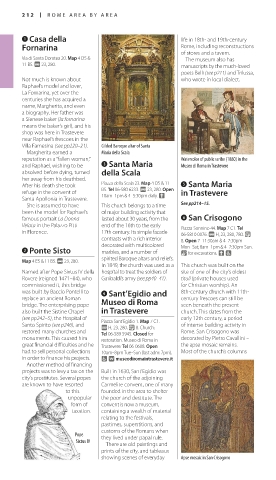
Villa Farnesina (see pp220–21). Gilded Baroque altar of Santa
Margherita earned a Maria della Scala
repu tation as a “fallen woman,” Watercolor of public scribe (1880) in the
and Raphael, wishing to be 3 Santa Maria Museo di Roma in Trastevere
absolved before dying, turned della Scala
her away from his deathbed.
After his death she took Piazza della Scala 23. Map 4 D5 & 11 5 Santa Maria
refuge in the convent of B5. Tel 06-580 6233. @ 23, 280. Open in Trastevere
10am–1pm & 4–5:30pm daily. 5
Santa Apollonia in Trastevere.
She is assumed to have This church belongs to a time See pp214–15.
been the model for Raphael’s of major building activity that
famous portrait La Donna lasted about 30 years, from the 6 San Crisogono
Velata in the Palazzo Pitti end of the 16th to the early Piazza Sonnino 44. Map 7 C1. Tel
in Florence. 17th century. Its simple facade 06-5810 0076. @ H, 23, 280, 780. v
contrasts with a rich interior 8. Open 7–11:30am & 4–7:30pm
decorated with multicolored Mon–Sat; 8am–1pm & 4–7:30pm Sun.
2 Ponte Sisto marbles, and a number of & for excavations. 5 7
spirited Baroque altars and reliefs.
Map 4 E5 & 11 B5. @ 23, 280.
In 1849, the church was used as a This church was built on the
Named after Pope Sixtus IV della hospital to treat the soldiers of site of one of the city’s oldest
Rovere (reigned 1471–84), who Gari baldi’s army (see pp40–41). tituli (private houses used
commissioned it, this bridge for Christian worship). An
was built by Baccio Pontelli to 4 Sant’Egidio and 8th-century church with 11th-
replace an ancient Roman Museo di Roma century frescoes can still be
bridge. The enterprising pope seen beneath the present
also built the Sistine Chapel in Trastevere church. This dates from the
(see pp242–5), the Hospital of Piazza Sant’Egidio 1. Map 7 C1. early 12th century, a period
Santo Spirito (see p246), and @ H, 23, 280. v 8. Church: of intense building activity in
restored many churches and Tel 06-589 5945. Closed for Rome. San Crisogono was
monuments. This caused him restoration. Museo di Roma in decorated by Pietro Cavallini –
great financial difficulties and he Trastevere: Tel 06-0608. Open the apse mosaic remains.
had to sell personal collections 10am–8pm Tue–Sun (last adm: 7pm). Most of the church’s columns
in order to finance his projects. 7 ∑ museodiromaintrastevere.it
Another method of finan cing
projects was to levy a tax on the Built in 1630, Sant’Egidio was
city’s prostitutes. Several popes the church of the adjoining
are known to have resorted Carmelite convent, one of many
to this founded in the area to shelter
unpopular the poor and destitute. The
form of convent is now a museum,
taxation. containing a wealth of material
relating to the festivals,
pastimes, superstitions, and
customs of the Romans when
Pope they lived under papal rule.
Sixtus IV
There are old paintings and
prints of the city, and tableaux
showing scenes of everyday Apse mosaic in San Crisogono
US_212-213_EW_Rome_US.indd 212 15/03/17 4:20 pm
Eyewitness Travel LAYERS PRINTED:
Catalogue template “UK” LAYER
(Source v1.9)
Date 20th August 2012
Size 125mm x 217mm

