


Page 245 - (DK Eyewitness) Travel Guide - Rome
P. 245
V A TIC AN 243
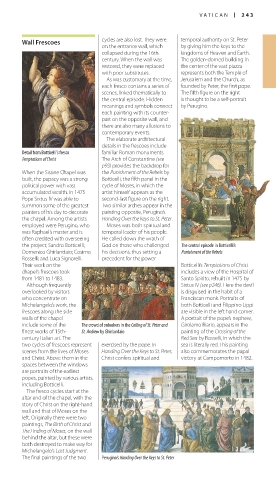
Wall Frescoes cycles are also lost. They were temporal authority on St. Peter
on the entrance wall, which by giving him the keys to the
collapsed during the 16th kingdoms of Heaven and Earth.
century. When the wall was The golden-domed building in
restored, they were replaced the center of the vast piazza
with poor substitutes. represents both the Temple of
As was customary at the time, Jerusalem and the Church, as
each fresco contains a series of founded by Peter, the first pope.
scenes, linked thematically to The fifth figure on the right
the central episode. Hidden is thought to be a self-portrait
meanings and symbols connect by Perugino.
each painting with its counter-
part on the opposite wall, and
there are also many allusions to
contemporary events.
The elaborate architectural
details in the frescoes include
Detail from Botticelli’s fresco familiar Roman monuments.
Temptations of Christ The Arch of Constantine (see
p93) provides the backdrop for
When the Sistine Chapel was the Punishment of the Rebels by
built, the papacy was a strong Botticelli, the fifth panel in the
political power with vast cycle of Moses, in which the
accumulated wealth. In 1475 artist himself appears as the
Pope Sixtus IV was able to second-last figure on the right.
summon some of the greatest Two similar arches appear in the
painters of his day to decorate painting opposite, Perugino’s
the chapel. Among the artists Handing Over the Keys to St. Peter.
employed were Perugino, who Moses was both spiritual and
was Raphael’s master and is temporal leader of his people.
often credited with overseeing He called down the wrath of
the project; Sandro Botticelli; God on those who challenged The central episode in Botticelli’s
Domenico Ghirlandaio; Cosimo his decisions, thus setting a Punishment of the Rebels
Rosselli; and Luca Signorelli. precedent for the power
Their work on the Botticelli’s Temptations of Christ
chapel’s frescoes took includes a view of the Hospital of
from 1481 to 1483. Santo Spirito, rebuilt in 1475 by
Although frequently Sixtus IV (see p246). Here the devil
overlooked by visitors is disguised in the habit of a
who concentrate on Franciscan monk. Portraits of
Michelangelo’s work, the both Botticelli and Filippino Lippi
frescoes along the side are visible in the left hand corner.
walls of the chapel A portrait of the pope’s nephew,
include some of the The crowd of onlookers in the Calling of St. Peter and Girolamo Riario, appears in the
finest works of 15th- St. Andrew by Ghirlandaio painting of the Crossing of the
century Italian art. The Red Sea by Rosselli, in which the
two cycles of frescoes represent exercised by the pope. In sea is literally red. This painting
scenes from the lives of Moses Handing Over the Keys to St. Peter, also commemorates the papal
and Christ. Above them in the Christ confers spiritual and victory at Campomorto in 1482.
spaces between the windows
are portraits of the earliest
popes, painted by various artists,
including Botticelli.
The fresco cycles start at the
altar end of the chapel, with the
story of Christ on the right-hand
wall and that of Moses on the
left. Originally there were two
paintings, The Birth of Christ and
The Finding of Moses, on the wall
behind the altar, but these were
both destroyed to make way for
Michelangelo’s Last Judgment.
The final paintings of the two Perugino’s Handing Over the Keys to St. Peter
US_242-243_EW_Rome_US.indd 243 15/03/17 3:53 pm

