


Page 243 - (DK Eyewitness) Travel Guide - Rome
P. 243
V A TIC AN 241
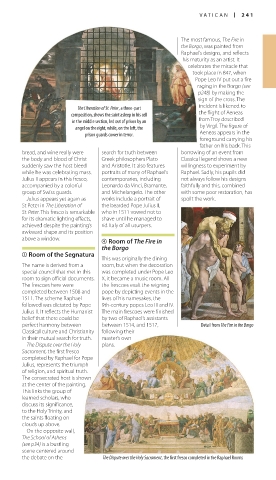
The most famous, The Fire in
the Borgo, was painted from
Raphael’s designs, and reflects
his maturity as an artist. It
celebrates the miracle that
took place in 847, when
Pope Leo IV put out a fire
raging in the Borgo (see
p248) by making the
sign of the cross. The
The Liberation of St. Peter, a three-part incident is likened to
composition, shows the saint asleep in his cell the flight of Aeneas
in the middle section, led out of prison by an from Troy described
angel on the right, while, on the left, the by Virgil. The figure of
prison guards cower in terror. Aeneas appears in the
foreground carrying his
father on his back. This
bread, and wine really were search for truth between borrow ing of an event from
the body and blood of Christ Greek philosophers Plato Classical legend shows a new
suddenly saw the host bleed and Aristotle. It also features willingness to experiment by
while he was celebrating mass. portraits of many of Raphael’s Raphael. Sadly, his pupils did
Julius II appears in this fresco, contemporaries, including not always follow his designs
accompanied by a colorful Leonardo da Vinci, Bramante, faithfully and this, combined
group of Swiss guards. and Michelangelo. The other with some poor restoration, has
Julius appears yet again as works include a portrait of spoilt the work.
St Peter in The Liberation of the bearded Pope Julius II,
St. Peter. This fresco is remarkable who in 1511 vowed not to
for its dramatic lighting effects, shave until he managed to
achieved despite the painting’s rid Italy of all usurpers.
awkward shape and its position
above a window.
4 Room of The Fire in
the Borgo
3 Room of the Segnatura
This was originally the dining
The name is derived from a room, but when the deco ration
special council that met in this was completed under Pope Leo
room to sign official documents. X, it became a music room. All
The frescoes here were the frescoes exalt the reigning
completed between 1508 and pope by depicting events in the
1511. The scheme Raphael lives of his namesakes, the
followed was dictated by Pope 9th-century popes Leo III and IV.
Julius II. It reflects the Humanist The main frescoes were finished
belief that there could be by two of Raphael’s assistants
perfect harmony between between 1514, and 1517, Detail from The Fire in the Borgo
Classical culture and Christianity following their
in their mutual search for truth. master’s own
The Dispute over the Holy plans.
Sacrament, the first fresco
completed by Raphael for Pope
Julius, represents the triumph
of religion, and spiritual truth.
The consecrated host is shown
at the center of the painting.
This links the group of
learned scholars, who
discuss its significance,
to the Holy Trinity, and
the saints floating on
clouds up above.
On the opposite wall,
The School of Athens
(see p34) is a bustling
scene centered around
the debate on the The Dispute over the Holy Sacrament, the first fresco completed in the Raphael Rooms
US_240-241_EW_Rome_US.indd 241 15/03/17 4:21 pm

