


Page 240 - (DK Eyewitness) Travel Guide - Rome
P. 240
238 ROME AREA B Y AREA
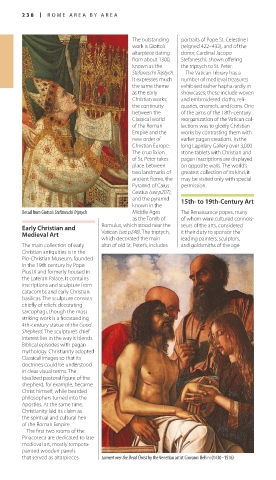
The outstanding portraits of Pope St. Celestine I
work is Giotto’s (reigned 422–432), and of the
altarpiece dating donor, Cardinal Jacopo
from about 1300, Stefaneschi, shown offering
known as the the triptych to St. Peter.
Stefaneschi Triptych. The Vatican Library has a
It expresses much number of medieval treasures
the same theme exhibited rather haphazardly in
as the early showcases; these include woven
Christian works: and embroidered cloths, reli
the continuity quaries, enamels, and icons. One
between the of the aims of the 18thcentury
Classical world reorganization of the Vatican col
of the Roman lections was to glorify Christian
Empire and the works by contrasting them with
new order of earlier pagan creations. In the
Christian Europe. long Lapidary Gallery over 3,000
The crucifixion stone tablets with Christian and
of St. Peter takes pagan inscriptions are displayed
place between on opposite walls. The world’s
two landmarks of greatest collection of its kind, it
ancient Rome, the may be visited only with special
Pyramid of Caius permission.
Cestius (see p207),
and the pyramid 15th- to 19th-Century Art
known in the
Detail from Giotto’s Stefaneschi Triptych Middle Ages The Renaissance popes, many
as the Tomb of of whom were cultured connois
Early Christian and Romulus, which stood near the seurs of the arts, considered
Medieval Art Vatican (see p248). The triptych, it their duty to sponsor the
which decorated the main leading painters, sculptors,
The main collection of early altar of old St. Peter’s, includes and goldsmiths of the age.
Christian antiquities is in the
PioChristian Museum, founded
in the 19th century by Pope
Pius IX and formerly housed in
the Lateran Palace. It contains
inscriptions and sculpture from
catacombs and early Christian
basilicas. The sculpture consists
chiefly of reliefs decorating
sarcophagi, though the most
striking work is a freestanding
4thcentury statue of the Good
Shepherd. The sculpture’s chief
interest lies in the way it blends
Biblical episodes with pagan
mythology. Christianity adopted
Classical images so that its
doctrines could be understood
in clear visual terms. The
idealized pastoral figure of the
shepherd, for example, became
Christ himself, while bearded
philosophers turned into the
Apostles. At the same time,
Christianity laid its claim as
the spiritual and cultural heir
of the Roman Empire.
The first two rooms of the
Pinacoteca are dedicated to late
medieval art, mostly tempera
painted wooden panels
that served as altarpieces. Lament over the Dead Christ by the Venetian artist Giovanni Bellini (1430–1516)
US_238-239_EW_Rome_US.indd 238 15/03/17 4:21 pm
Eyewitness Travel LAYERS PRINTED:
Flashmap follow-on template “UK” LAYER
(Source v1.3)
Date 18th October 2012
Size 125mm x 217mm

