


Page 32 - (DK Eyewitness) Travel Guide - Rome
P. 32
30 INTRODUCING ROME
The Papacy
The pope is considered Christ’s representative on earth,
claiming his authority from St. Peter, the first Bishop of Rome.
Though some popes have been great thinkers and reformers,
the role has rarely been purely spiritual. In the Middle Ages,
many popes were involved in power struggles with the Holy
Roman Emperor. Renaissance
popes like Julius II and Leo X,
the patrons of Raphael and
Michelangelo, lived as
luxuriously as any secular
prince. The popes listed here
include all those who exercised
significant political or religious
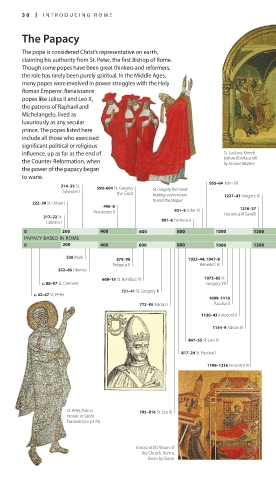
influence, up as far as the end of St. Ludovic Kneels
the Counter-Reformation, when before Boniface VIII
by Simone Martini
the power of the papacy began
to wane.
955–64 John XII
314–35 St. 590–604 St. Gregory
Sylvester I St. Gregory the Great
the Great leading a procession 1227–41 Gregory IX
to end the plague
222–30 St. Urban I
496–8 1216–27
Anastasius II 931–5 John XI Honorius III Savelli
217–22 St.
Callixtus I 891–6 Formosus
0 200 400 600 800 1000 1200
PAPACY BASED IN ROME
0 200 400 600 800 1000 1200
336 Mark
579–90 1032–44, 1047–8
Pelagius II Benedict IX
352–66 Liberius
608–15 St. Boniface IV 1073–85 St.
c. 88–97 St. Clement Gregory VII
731–41 St. Gregory III
c. 42–67 St. Peter
1099–1118
772–95 Adrian I Paschal II
1130–43 Innocent II
1154–9 Adrian IV
847–55 St. Leo IV
817–24 St. Paschal I
1198–1216 Innocent III
St. Peter, from a 795–816 St. Leo III
mosaic in Santa
Prassede (see p173)
Innocent III’s Vision of
the Church, from a
fresco by Giotto
US_030-031_EW_Rome_US.indd 30 15/03/17 4:19 pm

