


Page 37 - (DK Eyewitness) Travel Guide - Rome
P. 37
THE HIST OR Y OF ROME 35
Where to See
Renaissance Rome
The Campo de’ Fiori area
(see pp144–55) is full of grand
Renaissance palazzi, especially
along Via Giulia (pp278–9). Across
the river stands the delightful
Villa Farnesina (pp220–21).
The most typical church of
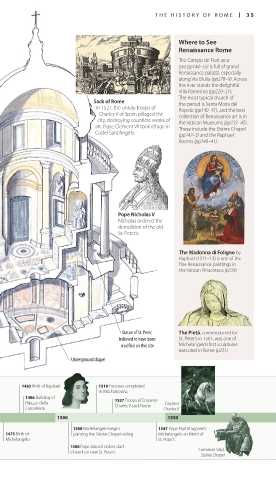
Sack of Rome the period is Santa Maria del
In 1527, the unruly troops of Popolo (pp140–41), and the best
Charles V of Spain pillaged the collection of Renaissance art is in
city, destroying countless works of the Vatican Museums (pp232–45).
art. Pope Clement VII took refuge in These include the Sistine Chapel
Castel Sant’Angelo. (pp242–5) and the Raphael
Rooms (pp240–41).
Pope Nicholas V
Nicholas ordered the
demolition of the old
St. Peter’s.
The Madonna di Foligno by
Raphael (1511–12) is one of the
fine Renaissance paintings in
the Vatican Pinacoteca (p239).
Statue of St. Peter, The Pietà, commissioned for
believed to have been St. Peter’s in 1501, was one of
crucified on this site Michelangelo’s first sculptures
executed in Rome (p231).
Underground chapel
1483 Birth of Raphael 1519 Frescoes completed
in Villa Farnesina
1486 Building of
Palazzo della 1527 Troops of Emperor Emperor
Cancelleria Charles V sack Rome Charles V
1450 1500 1550
1508 Michelangelo begins 1547 Pope Paul III appoints
1475 Birth of painting the Sistine Chapel ceiling Michelangelo architect of
Michelangelo St. Peter’s
1506 Pope Julius II orders start
of work on new St. Peter’s Cumaean Sibyl,
Sistine Chapel
US_034-035_EW_Rome_US.indd 35 15/03/17 4:27 pm

