


Page 36 - (DK Eyewitness) Travel Guide - Rome
P. 36
34 INTRODUCING ROME
Renaissance Rome
Pope Nicholas V came to the throne in 1447 determined to
make Rome a city fit for the papacy. Among his successors,
men like Julius II and Leo X eagerly followed his lead, and
the city’s appearance was transformed. The Classical
ideals of the Renaissance inspired artists, architects, and
craftsmen, such as Michelangelo, Bramante, Raphael, and
Cellini, to build and decorate the churches and palaces of
a newly confident Rome. Extent of the City
1500 Today
Hemispherical
dome
Balustrade of
small columns
Classical colonnade
of 16 Doric columns
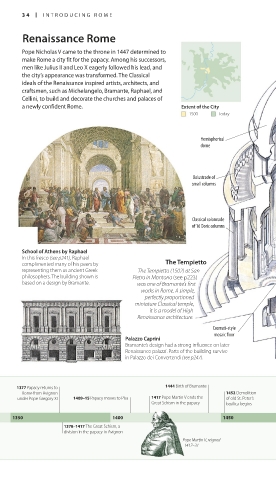
School of Athens by Raphael
In this fresco (see p241), Raphael
complimented many of his peers by The Tempietto
representing them as ancient Greek The Tempietto (1502) at San
philosophers. The building shown is Pietro in Montorio (see p223)
based on a design by Bramante. was one of Bramante’s first
works in Rome. A simple,
perfectly proportioned
miniature Classical temple,
it is a model of High
Renaissance architecture.
Cosmati-style
mosaic floor
Palazzo Caprini
Bramante’s design had a strong influence on later
Renaissance palazzi. Parts of the building survive
in Palazzo dei Convertendi (see p247).
1377 Papacy returns to 1444 Birth of Bramante
Rome from Avignon 1452 Demolition
under Pope Gregory XI 1409–15 Papacy moves to Pisa 1417 Pope Martin V ends the of old St. Peter’s
Great Schism in the papacy basilica begins
1350 1400 1450
1378–1417 The Great Schism, a
division in the papacy in Avignon 1475 Birth of
Pope Martin V, reigned Michelangelo
1417–31
US_034-035_EW_Rome_US.indd 34 15/03/17 4:27 pm

