


Page 59 - (DK Eyewitness) Travel Guide - Rome
P. 59
ROME A T A GLANCE 57
been in the tiny Piazza Mattei
since 1581, and by Santa Maria
in Domnica is the Fontana della
Navicella (little boat), created
out of an ancient Roman
sculpture in the 16th century.
In the forecourt of Santa Sabina
(map 8 D2) water gushes from
a huge mask set in an ancient
basin. The Pantheon Fountain
(map 4 F4), from 1575, is by
Jacopo della Porta. Le Quattro
Fontane (four fountains) have
stood at the Quirinal hill
intersection since 1593.
Fountains in parks and
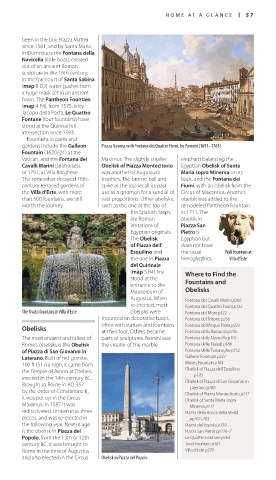
gardens include the Galleon Piazza Navona with Fontana dei Quattro Fiumi, by Pannini (1691–1765)
Fountain (1620–21) at the
Vatican, and the Fontana dei Maximus. The slightly smaller elephant balancing the
Cavalli Marini (seahorses), Obelisk of Piazza Montecitorio Egyptian Obelisk of Santa
of 1791, at Villa Borghese. was another of Augustus’s Maria sopra Minerva on its
The somewhat decayed 16th- trophies. The bronze ball and back, and the Fontana dei
century terraced gardens of spike at the top recall its past Fiumi, with an obelisk from the
the Villa d’Este, with more use as a gnomon for a sundial of Circus of Maxentius. Another
than 500 fountains, are still vast proportions. Other obelisks, obelisk was added to the
worth the journey. such as the one at the top of remodeled Pantheon Fountain
the Spanish Steps, in 1711. The
are Roman obelisk in
imitations of Piazza San
Egyptian originals. Pietro is
The Obelisk Egyptian but
of Piazza dell’ does not have
Esquilino and the usual Wall fountain at
the one in Piazza hieroglyphics. Villa d’Este
del Quirinale
(map 5 B4) first Where to Find the
stood at the
entrance to the Fountains and
Mausoleum of Obelisks
Augustus. When Fontana dei Cavalli Marini p260
re-erected, most Fontana dei Quattro Fiumi p122
The Ovato fountain at Villa d’Este obelisks were Fontana del Moro p122
mounted on decorative bases, Fontana del Tritone p256
often with statues and fountains Fontana dell’Acqua Paola p223
Obelisks at their foot. Others became Fontana della Barcaccia p135
The most ancient and tallest of parts of sculptures. Bernini was Fontana della Navicella p195
Rome’s obelisks is the Obelisk the creator of the marble Fontana delle Naiadi p166
of Piazza di San Giovanni in Fontana delle Tartarughe p152
Laterano. Built of red granite, Galleon Fountain p227
100 ft (31 m) high, it came from Moses Fountain p164
the Temple of Amon at Thebes, Obelisk of Piazza dell’Esquilino
p170
erected in the 14th century BC. Obelisk of Piazza di San Giovanni in
Brought to Rome in AD 357 Laterano p180
by the order of Constantine II, Obelisk of Piazza Montecitorio p117
it was put up in the Circus Obelisk of Santa Maria sopra
Maximus. In 1587 it was Minerva p112
rediscovered, broken into three Piazza della Bocca della Verità
pieces, and was re-erected in pp202–203
the following year. Next in age Piazza del Popolo p139
is the obelisk in Piazza del Piazza San Pietro pp226–7
Popolo, from the 13th or 12th Le Quattro Fontane p164
century BC. It was brought to Trevi Fountain p161
Rome in the time of Augustus Villa d’Este p270
and also erected in the Circus Obelisk in Piazza del Popolo
056-057_EW_Rome_US.indd 57 15/03/17 3:45 pm

