


Page 60 - (DK Eyewitness) Travel Guide - Rome
P. 60
58 INTRODUCING ROME
Artists and Writers Inspired by Rome
Artists and writers have been attracted to Rome since
Classical times. Many came to work for the emperors; the
poets Horace, Virgil, and Ovid, for example, all enjoyed
the patronage of Emperor Augustus. Later on, especially in
the Renaissance and Baroque periods, the greatest artists
and architects came to Rome to compete for commissions
from the popes. However, patronage was not the only
magnet. Since the Renaissance, Rome’s Classical past and its
picturesque ruins have drawn artists, architects, and writers
from all over Italy and abroad.
life. The Carracci family from Self-portrait by the 18th-century artist
Bologna also flourished – Angelica Kauffmann, c. 1770
especially brothers Annibale
(1560–1609) and Agostino (1577–1640) came from Antwerp
(1557–1602). to study, and carried out various
The work of Gian Lorenzo commissions. The French artists
Bernini (1598–1680) can be seen Nicolas Poussin (1594–1665)
all over Rome. He succeeded and Claude Lorrain (1600–82)
Carlo Maderno (1556–1629) lived here for many years.
as architect of St. Peter’s, and The Classical revival of the
created its great bronze 18th century attracted artists
baldacchino, the splendid to Rome in unprecedented
colonnade (see pp228–9), and numbers. From Britain came the
numerous fountains, churches, Scottish architect Robert Adam
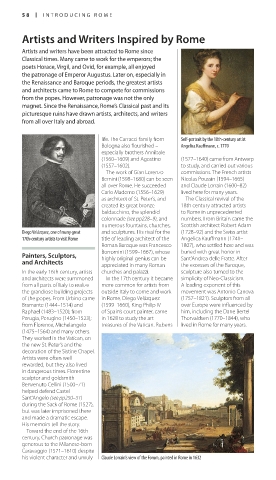
Diego Velázquez, one of many great and sculptures. His rival for the (1728–92) and the Swiss artist
17th-century artists to visit Rome title of leading architect of the Angelica Kauffmann (1741–
Roman Baroque was Francesco 1807), who settled here and was
Borromini (1599–1667), whose buried with great honor in
Painters, Sculptors, highly original genius can be Sant’Andrea delle Fratte. After
and Architects appreciated in many Roman the excesses of the Baroque,
In the early 16th century, artists churches and palazzi. sculpture also turned to the
and architects were summoned In the 17th century it became simplicity of Neo-Classicism.
from all parts of Italy to realize more common for artists from A leading exponent of this
the grandiose building projects outside Italy to come and work movement was Antonio Canova
of the popes. From Urbino came in Rome. Diego Velázquez (1757–1821). Sculptors from all
Bramante (1444–1514) and (1599–1660), King Philip IV over Europe were influenced by
Raphael (1483–1520); from of Spain’s court painter, came him, including the Dane Bertel
Perugia, Perugino (1450–1523); in 1628 to study the art Thorvaldsen (1770–1844), who
from Florence, Michelangelo treasures of the Vatican. Rubens lived in Rome for many years.
(1475–1564) and many others.
They worked in the Vatican, on
the new St. Peter’s and the
decoration of the Sistine Chapel.
Artists were often well
rewarded, but they also lived
in dangerous times. Florentine
sculptor and goldsmith
Benvenuto Cellini (1500–71)
helped defend Castel
Sant’Angelo (see pp250–51)
during the Sack of Rome (1527),
but was later imprisoned there
and made a dramatic escape.
His memoirs tell the story.
Toward the end of the 16th
century, Church patronage was
generous to the Milanese-born
Caravaggio (1571–1610) despite
his violent character and unruly Claude Lorrain’s view of the Forum, painted in Rome in 1632
US_058-059_EW_Rome_US.indd 58 15/03/17 3:52 pm

