


Page 61 - (DK Eyewitness) Travel Guide - Rome
P. 61
ROME A T A GLANCE 59
In the Romantic period,
Writers
Rome teemed with
Dante (1262–1321) visited English writers: Keats,
Rome during his exile from Shelley, and Byron,
Florence and in the Inferno followed by the
describes the great influx of Brownings and Charles
pilgrims for the first Holy Year Dickens. Travel writers
(1300). The poet Petrarch in the 19th century
(1304–74), born in Arezzo, was included Augustus Hare
crowned with laurels on the (1834–1903) and the
Capitol in 1341. The poet German historian
Torquato Tasso (1544–95), from Ferdinand Gregorovius
Sorrento, was invited to receive (1821–91). Much of
a similar honor, but died soon The Portrait of a Lady
after his arrival. He is buried in by American Henry
Sant’Onofrio (see p223) on the James (1843–1916) is
Janiculum. Two of the first set in Rome.
writers from abroad to visit Modern life in Rome
Rome were the French essayist is brilliantly captured
Montaigne (1533– by the Roman writer
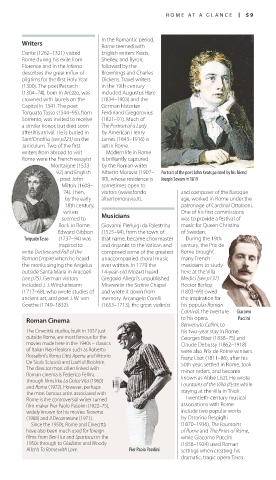
92) and English Alberto Moravia (1907– Portrait of the poet John Keats painted by his friend
poet John 90), whose residence is Joseph Severn in 1819
Milton (1608– sometimes open to
74). Then, visitors (www.fondo and composer of the Baroque
by the early albertomoravia.it). age, worked in Rome under the
18th century, patronage of Cardinal Ottoboni.
writers One of his first commissions
seemed to Musicians was to provide a festival of
flock to Rome. Giovanni Pierluigi da Palestrina music for Queen Christina
Edward Gibbon (1525–94), from the town of of Sweden.
Torquato Tasso (1737–94) was that name, became choirmaster During the 19th
inspired to and organist to the Vatican and century, the Prix de
write Decline and Fall of the composed some of the greatest Rome brought
Roman Empire when he heard unaccompanied choral music many French
the monks singing the Angelus ever written. In 1770 the musicians to study
outside Santa Maria in Aracoeli 14-year-old Mozart heard here at the Villa
(see p75). German visitors Gregorio Allegri’s unpublished Medici (see p137).
included J. J. Winckel mann Miserere in the Sistine Chapel Hector Berlioz
(1717–68), who wrote studies of and wrote it down from (1803–69) owed
ancient art, and poet J. W. von memory. Arcangelo Corelli the inspiration for
Goethe (1749–1832). (1653–1713), the great violinist his popular Roman
Carnival, the overture Giacomo
Roman Cinema to his opera Puccini
Benvenuto Cellini, to
The Cinecittà studios, built in 1937 just his two-year stay in Rome.
outside Rome, are most famous for the Georges Bizet (1838–75) and
movies made here in the 1940s – classics Claude Debussy (1862–1918)
of Italian Neo-Realism such as Roberto were also Prix de Rome winners.
Rossellini’s Roma Città Aperta and Vittorio Franz Liszt (1811–86), after his
De Sica’s Sciuscià and Ladri di Biciclette. 50th year, settled in Rome, took
The director most often linked with minor orders, and became
Roman cinema is Federico Fellini, known as Abbé Liszt. He wrote
through films like La Dolce Vita (1960)
and Roma (1972). However, perhaps Fountains of the Villa d’Este while
the most famous artist associated with staying at the villa in Tivoli.
Rome is the controversial writer-turned- Twentieth-century musical
film-maker Pier Paolo Pasolini (1922–75), associations with Rome
widely known for his movies Teorema include two popular works
(1968) and Il Decamerone (1971). by Ottorino Respighi
Since the 1950s, Rome and Cinecittà (1870–1936), The Fountains
have also been much used for foreign of Rome and The Pines of Rome,
films: from Ben-Hur and Spartacus in the while Giacomo Puccini
1950s through to Gladiator and Woody (1858–1924) used Roman
Allen’s To Rome with Love. Pier Paolo Pasolini settings when creating his
dramatic, tragic opera Tosca.
US_058-059_EW_Rome_US.indd 59 15/03/17 3:52 pm

