


Page 104 - (DK Eyewitness) Top 10 Travel Guide - Israel & Petra
P. 104
102  ❯❯  Israel and Petra Area by Area

            Petra


     This spectacular Nabataean city was hewn out of
     red-rock mountains and sandstone gorges. The
     carved tombs and temples of one of the world’s
     most atmospheric ancient sites have sparked
     travelers’ imaginations since the city's rediscovery
     in 1812. Built between the 3rd century BC and
     the 1st century AD, Petra became the capital
     of a vast trading empire. The Romans annexed
     it in AD 106; later, the Byzantines built churches
     here; even the Crusaders passed through.
     Known as the “rose-red city,” it has monumental   Archeological
     façades that reflect the swirls of color that pattern   Museum relief
     the surrounding hills and valleys. The hiking here is excellent, with
     peripheral peaks, altars, and tombs offering greater challenges.
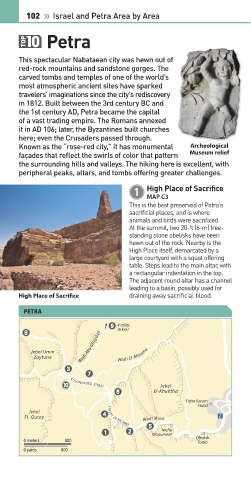
                                  High Place of Sacrifice
                              1
                                  MAP C3
                              This is the best preserved of Petra’s
                              sacrificial places, and is where
                              animals and birds were sacrificed.
                              At the summit, two 20-ft (6-m) free-
                              standing stone obelisks have been
                              hewn out of the rock. Nearby is the
                              High Place itself, demarcated by a
                              large courtyard with a squat offering
                              table. Steps lead to the main altar, with
                              a rectangular indentation in the top.
                              The adjacent round altar has a channel
                              leading to a basin, possibly used for
     High Place of Sacrifice  draining away sacrificial blood.
      PETRA

                            4 miles
                            (6 km)
                   Wadi Abu Ullaydqa
        Jebel Umm           Wadi El-Mataha
         Zaytuna


                                     Jebel
                 COLONNADED  STREET
                                    El-Khubtha
                                           Petra Forum
                                              Hotel
        Jebel
       EL-Quray           ST R E ET  OF FACADES  Wadi Musa
                                      Niche
                                   Monument
      0 meters  800                          Obelisk
                                              Tomb
      0 yards  800


     Eyewitness Travel – Top 10 series  LAYERS PRINTED:
     Two-column, 8.5pt grid  “UK” LAYER
     (SourceReport v.1.9)
 102-105_Top_10_Israel.indd   102                     19/06/2017   12:58
     Date 24th June 2015
     Size 100mm x 191mm

