


Page 108 - (DK Eyewitness) Top 10 Travel Guide - Brussels Bruges Ghent & Antwerp
P. 108
106 BEY OND BRUSSELS
Exploring Northeast Bruges
In the height of the summer and on holiday weekends,
tourists pour into Bruges, and parts of the city centre often
get too crowded for comfort. Fortunately, the narrow cobbled
streets and picturesque canals to the north east of the Markt
never suffer from this, and this fascinating area remains one
of the most delightful parts of Bruges. Streets of charming
terraced houses are dotted with grand, yet elegant
18th-century mansions. The best approach is via Jan van
Eyckplein, in medieval times the city’s busiest harbour, from
where it is a short stroll along Spinolarei and Potterierei
streets to the many museums and churches that are found in
this historic district.
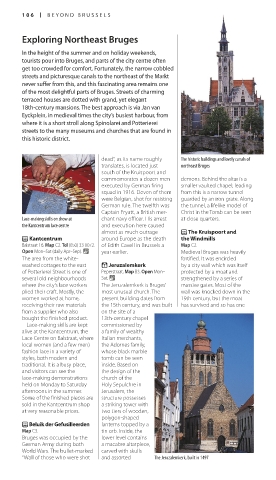
dead”, as its name roughly The historic buildings and lovely canals of
translates, is located just northeast Bruges
south of the Kruispoort and
commemorates a dozen men demons. Behind the altar is a
executed by German firing smaller vaulted chapel; leading
squad in 1916. Eleven of them from this is a narrow tunnel
were Belgian, shot for resisting guarded by an iron grate. Along
German rule. The twelfth was the tunnel, a lifelike model of
Captain Fryatt, a British mer- Christ in the Tomb can be seen
Lace-making skills on show at chant navy officer. His arrest at close quarters.
the Kantcentrum lace centre and execution here caused
almost as much outrage P The Kruispoort and
P Kantcentrum around Europe as the death the Windmills
Balstraat 16. Map C2. Tel (050) 33 0072. of Edith Cavell in Brussels a Map C2.
Open Mon–Sat (daily Apr–Sep). & year earlier. Medieval Bruges was heavily
The area from the white- fortified. It was encircled
washed cottages to the east R Jeruzalemkerk by a city wall which was itself
of Potterierei Street is one of Peperstraat. Map B3. Open Mon– protected by a moat and
several old neighbourhoods Sat. & strengthened by a series of
where the city’s lace workers The Jeruzalemkerk is Bruges’ massive gates. Most of the
plied their craft. Mostly, the most unusual church. The wall was knocked down in the
women worked at home, present building dates from 19th century, but the moat
receiving their raw materials the 15th century, and was built has survived and so has one
from a supplier who also on the site of a
bought the finished product. 13th-century chapel
Lace-making skills are kept commis sioned by
alive at the Kantcentrum, the a family of wealthy
Lace Centre on Balstraat, where Italian merchants,
local women (and a few men) the Adornes family,
fashion lace in a variety of whose black marble
styles, both modern and tomb can be seen
traditional. It is a busy place, inside. Based on
and visitors can see the the design of the
lace-making demon strations church of the
held on Monday to Saturday Holy Sepulchre in
afternoons in the summer. Jerusalem, the
Some of the finished pieces are structure possesses
sold in the Kantcentrum shop a striking tower with
at very reasonable prices. two tiers of wooden,
polygon-shaped
P Beluik der Gefusilleerden lan terns topped by a
Map C3. tin orb. Inside, the
Bruges was occupied by the lower level contains
German Army during both a macabre altarpiece,
World Wars. The bullet-marked carved with skulls
“Wall of those who were shot and assorted The Jeruzalemkerk, built in 1497
106-107_EW_Brussels.indd 106 10/01/17 10:54 am
Eyewitness Travel LAYERS PRINTED:
Catalogue template “UK” LAYER
(Source v2.7)
Date 1st October 2013
Size 125mm x 217mm

