


Page 114 - (DK Eyewitness) Top 10 Travel Guide - Brussels Bruges Ghent & Antwerp
P. 114
112 BEY OND BRUSSELS
Exploring Ghent R St Baafskathedraal
Sint Baafsplein. Map F2. Tel (09) 269
Ghent was founded in the 9th century when Baldwin Iron-Arm, 2045. Open daily. Closed 1 Jan. &
first Count of Flanders, built a castle to protect two abbeys from Built in several stages,
Viking raids. Its historic centre developed during the 13th and St Baafskathedraal (St Bavo’s
14th centuries, when the city prospered as a result of the cloth Cathedral) has features
repre senting every phase
trade. Despite religious and dynastic conflicts, Ghent con tinued of Gothic style, from the
to flourish throughout the 16th and early 17th centuries. early chancel through to the
After 1648, the Dutch sealed the Scheldt estuary near Antwerp, later cavernous nave, which
closing vital canal links, which led to a decline in the fortunes is supported by slender
of both cities. The 19th-century boom in cotton spinning columns and is the cathedral’s
architectural highlight. In a
reinvigorated Ghent and led to the building of wide boulevards small side chapel is one of
in the south of the city. Today, textiles still feature in Ghent’s Europe’s most remark able
industry, while its university lends youthful vibrancy to city life. paintings, Jan van Eyck’s
Visitors staying for more than a day will find the CityCard Gent polyptych Adoration of the
an econo mical way of seeing the city’s excellent museums. Mystic Lamb (1432). St Bavo
(or Bavon) was Ghent’s
own 7th-century saint,
who abandoned the life of a
wealthy degenerate to become
a missionary in France and
Flanders and then a hermit. He
was buried in about AD 653.
P Stadhuis
Botermarkt 1. Map F2. Tel (09) 266
7170. & 8 May–Oct: 3pm Mon–
Thu. Tours depart 2:30pm from the
Tourist Office.
Tiled flooring forms a maze in the Pacification Hall in Ghent’s Stadhuis The Stadhuis façade displays
two different architectural styles.
Getting Around trams travel to the centre Overlooking Hoogstraat, the
Ghent is a large city with an every few minutes. However, older half dates from the early
excellent bus and tram system. many of Ghent’s main sights 16th century, its tracery in the
The main rail station, Ghent are within walking distance elaborate Flamboyant Gothic
St-Pieters, adjoins the bus of each other. Canal boat trips style. The plainer, newer part,
station from where several are also available. which flanks the Botermarkt, is
The Adoration of the Mystic Lamb great early Flemish artists, Jan van
Eyck, and his lesser-known
brother, Hubrecht.
Completed in 1432, it is not
only exquisitely painted; it is also
an expression of the deepest
beliefs of Christianity – that human
salvation lies in the sacrifice of
Christ, the Lamb of God. What
you see today is almost entirely
original; only the lower left panel
is a modern copy, following its
theft in 1934. This is a remarkable
achievement, given the painting’s
history. It was rescued from
Protestant church-wreckers in
1566 and from fire in 1822; parts of
it were removed by French soldiers
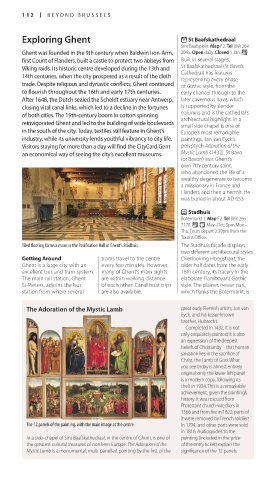
The 12 panels of the painting, with the main image at the centre in 1794, and other parts were sold
in 1816. Audioguides to the
In a side-chapel of Sint Baafskathedraal, in the centre of Ghent, is one of painting (included in the price
the greatest cultural treasures of northern Europe. The Adoration of the of the entry ticket) explain the
Mystic Lamb is a monumental, multi-panelled painting by the first of the significance of the 12 panels.
112-113_EW_Brussels.indd 112 10/01/17 11:04 am

