


Page 28 - (DK Eyewitness) Top 10 Travel Guide - Brussels Bruges Ghent & Antwerp
P. 28
26 INTRODUCING BRUSSELS
Tapestry and Lace
For over six centuries, Belgian lace and tapestry have
been highly prized luxury crafts. Originating in Flanders in
the 12th century, tapestry has since been handmade
in the centres of Tournai, Brussels, Arras, Mechelen and
Oudenaarde, while the lace trade was practised from the
1500s onwards in all the Belgian provinces, with Bruges and
Brussels particularly renowned for their delicate work. The
makers often had aristocratic patrons; intricate lace and fine Tapestry weavers numbered
tapes tries were status symbols of the nobility and staple over 50,000 in Flanders from
exports throughout Europe from the 15th to 18th centuries. 1450 to 1550. With the ruling
Dukes of Burgundy as patrons,
Today, Belgium remains home to the very best tapestry and weavers prospered, and hang
lace studios in the world. ings grew more elaborate.
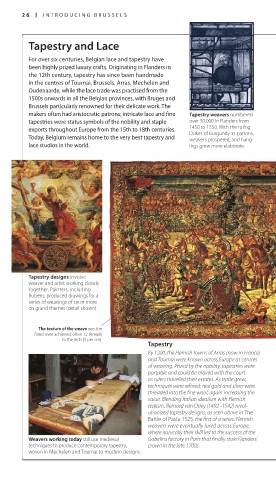
Tapestry designs involve
weaver and artist working closely
together. Painters, including
Rubens, produced drawings for a
series of weavings of six or more
on grand themes (detail shown).
The texture of the weave was the
finest ever achieved; often 12 threads
to the inch (5 per cm).
Tapestry
By 1200, the Flemish towns of Arras (now in France)
and Tournai were known across Europe as centres
of weaving. Prized by the nobility, tapestries were
portable and could be moved with the court
as rulers travelled their estates. As trade grew,
techniques were refined; real gold and silver were
threaded into the fine wool, again increasing the
value. Blending Italian idealism with Flemish
real ism, Bernard van Orley (1492–1542) revol
utionized tapestry designs, as seen above in The
Battle of Pavia 1525, the first of a series. Flemish
weavers were eventually lured across Europe,
where ironically their skill led to the success of the
Weavers working today still use medieval Gobelins factory in Paris that finally stole Flanders’
techniques to produce contemporary tapestry, crown in the late 1700s.
woven in Mechelen and Tournai to modern designs.
026-027_EW_Brussels.indd 26 10/01/17 10:54 am
Eyewitness Travel LAYERS PRINTED:
Feature template “UK” LAYER
(SourceReport v1.3)
Date 18th October 2012
Size 125mm x 217mm

