


Page 29 - (DK Eyewitness) Top 10 Travel Guide - Brussels Bruges Ghent & Antwerp
P. 29
A POR TR AIT OF BRUSSELS 27
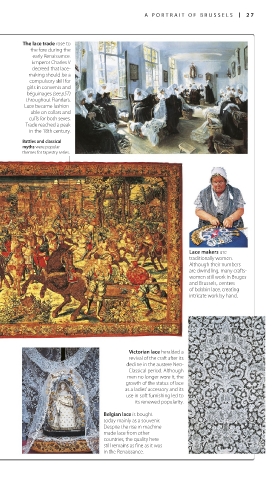
The lace trade rose to
the fore during the
early Renaissance.
Emperor Charles V
decreed that lace-
making should be a
compulsory skill for
girls in convents and
béguinages (see p57)
throughout Flanders.
Lace became fashion-
able on collars and
cuffs for both sexes.
Trade reached a peak
in the 18th century.
Battles and classical
myths were popular
themes for tapestry series.
Lace makers are
tradi tionally women.
Although their numbers
are dwin dling, many crafts-
women still work in Bruges
and Brussels, centres
of bobbin lace, creating
intricate work by hand.
Victorian lace heralded a
revival of the craft after its
dec line in the austere Neo-
Classical period. Although
men no longer wore it, the
growth of the status of lace
as a ladies’ accessory and its
use in soft furnishing led to
its renewed popularity.
Belgian lace is bought
today mainly as a souvenir.
Despite the rise in machine-
made lace from other
countries, the quality here
still remains as fine as it was
in the Renaissance.
026-027_EW_Brussels.indd 27 10/01/17 10:54 am

