


Page 35 - (DK Eyewitness) Top 10 Travel Guide - Brussels Bruges Ghent & Antwerp
P. 35
THE HIST OR Y OF BRUSSELS 33
THE HISTORY OF
BRUSSELS
As the cultural and civic heart of Belgium since the Middle Ages, Brussels has been
the focus of much political upheaval over the centuries. But, from the battles of the
17th century to the warfare of the 20th century, it has always managed to recreate
itself with vigour. Today, as the political centre of the European Union, Belgium’s
capital is prospering as never before.
When Julius Caesar set out to conquer Roman Emperor, ruling a vast area
the Gauls of north ern Europe in 58 BC, he extending from Denmark to Italy. By the
encountered a fierce tribe known as the 10th century, the inheritance laws of
Belgae (the origins of the 19th-century the Franks meant that the empire was
name “Belgium”). Roman victory led to divided up among Charlemagne’s
the estab lishment of the region they grandsons, Louis, Charles the Bald and
called Gallia Belgica. The earliest mention Lothair. Lothair’s fortress, founded in 977,
of Brussels itself is as “Broucsella”, or marks the official founding of Brussels.
“settlement in the marshes”, and dates The period had brought a measure of sta-
from a 7th-century manuscript. bility to the area’s volatile feudal fief doms,
Following the collapse of the Roman leading to a trading boom in the new
Empire in the 5th century, a Germanic towns of the low countries.
race known as the Franks came to
rule the region and established the Industrial Beginnings
Merovingian dynasty of kings, based At the start of the 12th century, com merce
in their capital at Tournai. They were became the guiding force in western
followed by the Carolingian dynasty, Europe and the centres of trade quickly
which produced one of the most grew into powerful cities. Rivers and
important figures of the Middle Ages – canals were key to the growth of
Charlemagne (AD 768–814). His noted the area’s trading towns. Ghent, Ypres,
military expertise ensured that invaders Antwerp and Bruges became the focus
such as the Northern Saxons and of the cloth trade plied across the North
the Lombards of Italy were repelled. Sea between France, Germany, Italy
He was also credited with establishing and England. Brussels, with its skilled
Christianity as the major religion across craftsmen, became a trade centre, and
western Europe. The pope rewarded him buildings such as the Cathédrale Sts
by crowning him Emperor of the West in Michel et Gudule (see pp74–5), started
AD 800; effec tively he was the first Holy in 1225, demonstrated its stature.
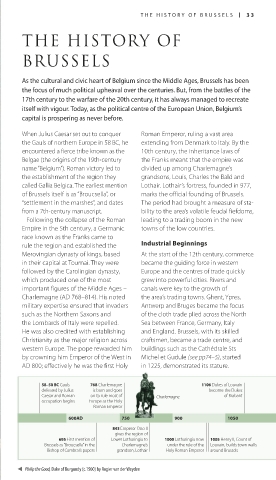
58–50 BC Gauls 768 Charlemagne 1106 Dukes of Louvain
defeated by Julius is born and goes become the Dukes
Caesar and Roman on to rule most of Charlemagne of Brabant
occupation begins Europe as the Holy
Roman Emperor
600AD 750 900 1050
843 Emperor Otto II
gives the region of
695 First mention of Lower Lotharingia to 1000 Lotharingia now 1005 Henry II, Count of
Brussels as “Broucsella” in the Charlemagne’s under the rule of the Louvain, builds town walls
Bishop of Cambrai’s papers grandson, Lothair Holy Roman Emperor around Brussels
Philip the Good, Duke of Burgundy (c.1500) by Rogier van der Weyden
032-033_EW_Brussels.indd 33 10/01/17 10:54 am

