


Page 38 - (DK Eyewitness) Top 10 Travel Guide - Brussels Bruges Ghent & Antwerp
P. 38
36 INTRODUCING BRUSSELS
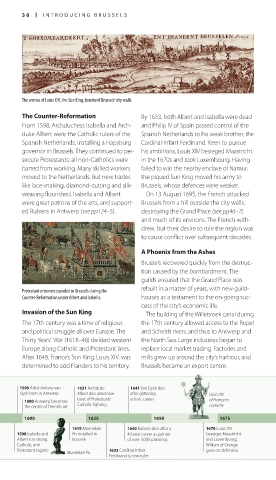
The armies of Louis XIV, the Sun King, bombard Brussels’ city walls
The Counter-Reformation By 1633, both Albert and Isabella were dead
From 1598, Archduchess Isabella and Arch- and Philip IV of Spain passed control of the
duke Albert were the Catholic rulers of the Spanish Netherlands to his weak brother, the
Spanish Netherlands, installing a Hapsburg Cardinal-Infant Ferdinand. Keen to pursue
governor in Brussels. They continued to per- his ambi tions, Louis XIV besieged Maastricht
secute Protestants: all non-Catholics were in the 1670s and took Luxembourg. Having
barred from working. Many skilled workers failed to win the nearby enclave of Namur,
moved to the Nether lands. But new trades the piqued Sun King moved his army to
like lace-making, diamond-cutting and silk- Brussels, whose defences were weaker.
weaving flourished. Isabella and Albert On 13 August 1695, the French attacked
were great patrons of the arts, and support- Brussels from a hill outside the city walls,
ed Rubens in Antwerp (see pp124–5). destroying the Grand Place (see pp46–7)
and much of its environs. The French with-
drew, but their desire to rule the region was
to cause con flict over subsequent decades.
A Phoenix from the Ashes
Brussels recovered quickly from the destruc-
tion caused by the bombardment. The
guilds ensured that the Grand Place was
rebuilt in a matter of years, with new guild-
Protestant prisoners paraded in Brussels during the
Counter-Reformation under Albert and Isabella houses as a tes tament to the on-going suc-
cess of the city’s economic life.
Invasion of the Sun King The building of the Willebroek canal during
The 17th century was a time of reli gious the 17th century allowed access to the Rupel
and political struggle all over Europe. The and Scheldt rivers, and thus to Antwerp and
Thirty Years’ War (1618–48) divided western the North Sea. Large industries began to
Europe along Catholic and Protestant lines. replace local market trading. Factories and
After 1648, France’s Sun King, Louis XIV, was mills grew up around the city’s harbour, and
determined to add Flanders to his territory. Brussels became an export centre.
1599 Artist Antony van 1621 Archduke 1641 Van Dyck dies 1695 French
Dyck born in Antwerp Albert dies amid new after glittering Louis XIV Bombardment
bout of Protestant/ artistic career of France in of Brussels
1600 Antwerp becomes
the centre of Flemish art Catholic fighting costume
1600 1625 1650 1675
1619 Manneken 1640 Rubens dies after a 1670 Louis XIV
1598 Isabella and Pis installed in 40-year career as painter beseiges Maastricht
Albert run strong Brussels of over 3,000 paintings and Luxembourg;
Catholic, anti- William of Orange
Protestant regime 1633 Cardinal-Infant goes on defensive
Manneken Pis
Ferdinand is new ruler
036-037_EW_Brussels.indd 36 10/01/17 10:54 am
Eyewitness Travel LAYERS PRINTED:
History Portrait template “UK” LAYER
(Source v1.2)
Date 20th August 2012
Size 125mm x 217mm

