


Page 40 - (DK Eyewitness) Top 10 Travel Guide - Brussels Bruges Ghent & Antwerp
P. 40
38 INTRODUCING BRUSSELS
The Fight for Independence
Belgium was again occupied by foreign powers between
1794 and 1830. First, by the French Republican armies, then,
after Napoleon’s defeat at Waterloo in 1815, by the Dutch.
French radical reforms included the abolition of the guild
system and fairer taxation laws. Although French rule was
unpopular, their liberal ideas were to influence the Belgian
drive for independence. William I of Orange was appointed
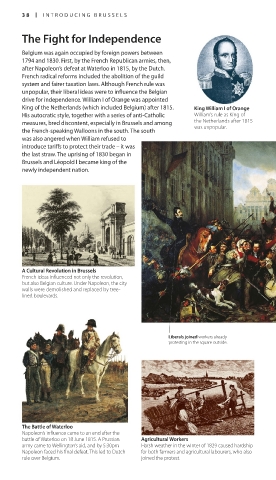
King of the Netherlands (which included Belgium) after 1815. King William I of Orange
His autocratic style, together with a series of anti-Catholic William’s rule as King of
measures, bred discontent, especially in Brussels and among the Netherlands after 1815
was unpopular.
the French-speaking Walloons in the south. The south
was also angered when William refused to
introduce tariffs to protect their trade – it was
the last straw. The uprising of 1830 began in
Brussels and Léopold I became king of the
newly independent nation.
A Cultural Revolution in Brussels
French ideas influenced not only the rev olution,
but also Belgian culture. Under Napoleon, the city
walls were demolished and replaced by tree-
lined boulevards.
Liberals joined workers already
protesting in the square outside.
The Battle of Waterloo
Napoleon’s influence came to an end after the
battle of Waterloo on 18 June 1815. A Prussian Agricultural Workers
army came to Wellington’s aid, and by 5:30pm Harsh weather in the winter of 1829 caused hardship
Napoleon faced his final defeat. This led to Dutch for both farmers and agricultural labourers, who also
rule over Belgium. joined the protest.
038-039_EW_Brussels.indd 38 10/01/17 10:54 am
Eyewitness Travel LAYERS PRINTED:
Starsight history template “UK” LAYER
(Source v1.2)
Date 7th January 2013
Size 125mm x 217mm

