


Page 42 - (DK Eyewitness) Top 10 Travel Guide - Brussels Bruges Ghent & Antwerp
P. 42
40 INTRODUCING BRUSSELS
population of Brussels had almost doubled,
The Flemish and the Walloons: resulting in poor-quality housing and
the Belgian Compromise
working condi tions. Towards the end of
Linguistically and culturally, the reign of Belgium’s second monarch,
Belgium is divided. In the north,
the Flemish have their roots in Léopold II (r.1865–1909), industrial unrest
the Netherlands and Germany. led to new legislation which improved
In the south are the Walloons,
the French-speaking Belgians, conditions, and all men over 25 gained the
culturally connected to France. right to vote in 1893. But the king’s principal
The “Linguistic Divide” of 1962 concern was his colonialist policy in the
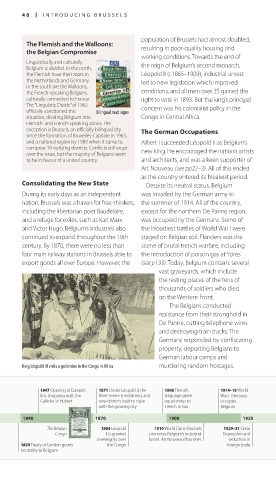
officially sanctioned this Bilingual road signs
situation, dividing Belgium into Congo in Central Africa.
Flemish- and French-speaking zones. The
exception is Brussels, an officially bilingual city The German Occupations
since the formation of Bruxelles-Capitale in 1963,
and a national region by 1989 when it came to Albert I succeeded Léopold II as Belgium’s
comprise 19 outlying districts. Conflicts still erupt new king. He encouraged the nation’s artists
over the issue, but the majority of Belgians seem
to be in favour of a united country. and architects, and was a keen supporter of
Art Nouveau (see pp22–3). All of this ended
as the country entered its bleakest period.
Consolidating the New State Despite its neutral status, Belgium
During its early days as an indepen dent was invaded by the German army in
nation, Brussels was a haven for free-thinkers, the summer of 1914. All of the coun try,
including the libertarian poet Baudelaire, except for the northern De Panne region,
and a refuge for exiles, such as Karl Marx was occupied by the Germans. Some of
and Victor Hugo. Belgium’s industries also the bloodiest battles of World War I were
continued to expand throughout the 19th staged on Belgian soil. Flanders was the
century. By 1870, there were no less than scene of brutal trench warfare, including
four main railway stations in Brussels able to the intro duction of poison gas at Ypres
export goods all over Europe. However, the (see p133). Today, Belgium contains several
vast graveyards, which include
the resting places of the tens of
thousands of soldiers who died
on the Western Front.
The Belgians conducted
resistance from their strong hold in
De Panne, cutting telephone wires
and destroy ing train tracks. The
Germans responded by confiscating
property, deporting Belgians to
German labour camps and
King Léopold III visits a goldmine in the Congo in Africa murdering random hostages.
1939–45
World War II.
1847 Opening of Europe’s 1871 Under Léopold II, the 1898 Flemish 1914–18 World Germany
first shopping mall, the River Senne is reclaimed, and language given War I. Germany again occupies
Galéries St Hubert new districts built to cope equal status to occupies Belgium
with the growing city French in law Belgium
1840 1870 1900 1925
The Belgian 1884 Léopold 1910 World Fair in Brussels 1929–31 Great
Congo II is granted promotes Belgium’s industrial Depression and
sovereignty over boom. Art Nouveau flourishes reduction in
1839 Treaty of London grants the Congo foreign trade
neutrality to Belgium
040-041_EW_Brussels.indd 40 10/01/17 10:54 am
Eyewitness Travel LAYERS PRINTED:
History Portrait template “UK” LAYER
(Source v1.2)
Date 20th August 2012
Size 125mm x 217mm

