


Page 57 - (DK Eyewitness) Top 10 Travel Guide - Brussels Bruges Ghent & Antwerp
P. 57
THE L OWER T OWN 55
VISITORS’ CHECKLIST
Practical Information
20 rue des Sables, 1000 BRU.
Map 2 E2. Tel (02) 219 1980.
Open daily (library closed Mon).
& 7 8 - =
∑ comicscenter.net
Transport
@ 29, 38, 46, 47, 61, 63,
Three Comic Figures 66, 71, 86, 88. v 3, 4, 32, 92, 94.
q Botanique, De Brouckère,
Tintin, Professor Calculus and Captain
Haddock greet visitors on the 1st floor. Rogier.
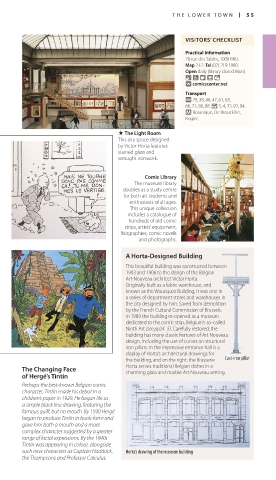
. The Light Room
This airy space designed
by Victor Horta features
stained glass and
wrought-ironwork.
Comic Library
The museum library
doubles as a study centre
for both art students and
enthu siasts of all ages.
This unique collection
includes a catalogue of
hundreds of old comic
strips, artists’ equipment,
biogra phies, comic novels
and photographs.
A Horta-Designed Building
This beautiful building was constructed between
1903 and 1906 to the design of the Belgian
Art-Nouveau architect Victor Horta.
Originally built as a fabric warehouse, and
known as the Waucquez Building, it was one in
a series of department stores and warehouses in
the city designed by him. Saved from demolition
by the French Cultural Commission of Brussels,
in 1989 the building re-opened as a museum
dedicated to the comic strip, Belgium’s so-called
Ninth Art (see pp24–5). Carefully restored, the
building has many classic features of Art Nouveau
design, including the use of curves on structural
iron pillars. In the impressive entrance hall is a
display of Horta’s architectural drawings for
the building, and on the right, the Brasserie Cast-iron pillar
The Changing Face Horta serves traditional Belgian dishes in a
charming glass and marble Art Nouveau setting.
of Hergé’s Tintin
Perhaps the best-known Belgian comic
character, Tintin made his debut in a
children’s paper in 1929. He began life as
a simple black line drawing, featuring the
famous quiff, but no mouth. By 1930 Hergé
began to produce Tintin in book-form and
gave him both a mouth and a more
complex character suggested by a greater
range of facial expressions. By the 1940s
Tintin was appearing in colour, alongside
such new characters as Captain Haddock, Horta’s drawing of the museum building
the Thompsons and Professor Calculus.
054-055_EW_Brussels.indd 55 10/01/17 11:04 am

