


Page 132 - (DK Eyewitness) Travel Guide - London
P. 132
130 L ONDON AREA B Y AREA
Exploring the British Museum’s Collections
The museum’s immense hoard of treasure spans two million cuneiform tablets. The
years of history and culture. Its 94 galleries, which stretch earliest of these are inscribed
2.5 miles (4 km), cover civilizations from ancient Egypt and with the oldest
Assyria to modern Japan. known pictographs
(c.3300 BC). Also
of interest is a
it pitched, played music, skull discovered
and even fired a cannon. in Jericho in the
Also nearby are the famous 1950s; aug-
12th-century Lewis chess- mented with
men. Baron Ferdinand shells and lime
Rothschild’s (1839–98) plaster, the skull
remarkably varied treasures, belonged to a
largely from the Renaissance hunter who lived in
and known as the Waddesdon the area some
1st-century BC bronze helmet dredged up Bequest, are beautifully 7,000 years ago.
from the Thames displayed in Room 2a.
Ornamental detail from
a Sumerian queen’s lyre
Prehistoric and
Roman Britain
Egypt
Relics of prehistoric Britain
are on display in six separate In Room 4 are Egyptian
galleries. The most impressive sculptures. These include a
items include the gold “Mold fine red granite head of a king,
Cape”, a ceremonial Bronze Age thought to depict Amenophis III,
cape found in Wales; an antlered and a colossal statue of King
head dress worn by hunter- Rameses II. Also on show
gatherers some 9,000 years ago; is the Rosetta Stone, used by
and “Lindow Man”, a 1st-century Jean-François Champollion
AD sacrificial victim who lay (1790–1832) as a key for
preserved in a bog until 1984. deciphering Egyptian
Some superb Celtic metal work hieroglyphs. An extraordinary
is also on show, along side the array of mummies, jewellery
silver Mildenhall Treasure and and Coptic art can also be
other Roman pieces. The Hinton found upstairs. The various
St Mary mosaic (4th century AD) instruments that were used by
features a roundel contain ing embalmers to preserve bodies
the earliest known British before entombment are all
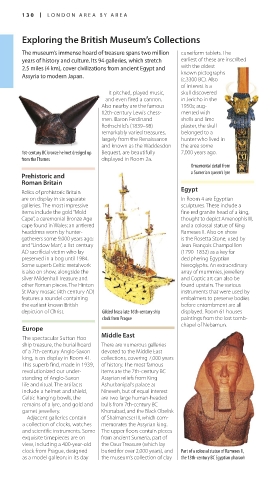
depiction of Christ. Gilded brass late 16th-century ship displayed. Room 61 houses
clock from Prague paintings from the lost tomb-
chapel of Nebamun.
Europe
Middle East
The spectacular Sutton Hoo
ship treasure, the burial hoard There are numerous galleries
of a 7th-century Anglo-Saxon devoted to the Middle East
king, is on display in Room 41. collections, covering 7,000 years
This superb find, made in 1939, of history. The most famous
revolutionized our under- items are the 7th-century BC
standing of Anglo-Saxon Assyrian reliefs from King
life and ritual. The artifacts Ashurbanipal’s palace at
include a helmet and shield, Nineveh, but of equal interest
Celtic hanging bowls, the are two large human-headed
remains of a lyre, and gold and bulls from 7th-century BC
garnet jewellery. Khorsabad, and the Black Obelisk
Adjacent galleries contain of Shalmaneser III, which com-
a collection of clocks, watches memorates the Assyrian king.
and scientific instruments. Some The upper floors contain pieces
exquisite timepieces are on from ancient Sumeria, part of
view, including a 400-year-old the Oxus Treasure (which lay
clock from Prague, designed buried for over 2,000 years), and Part of a colossal statue of Rameses II,
as a model galleon; in its day the museum’s collection of clay the 13th-century BC Egyptian pharaoh
130-131_EW_London.indd 130 21/03/17 2:20 pm

