


Page 133 - (DK Eyewitness) Travel Guide - London
P. 133
BL OOMSBUR Y AND FITZROVIA 131
Halicarnassus. The beautiful
Greece and Rome
1st-century BC cameo-glass
The Greek and Roman collections Portland Vase is located in the
include the mus eum’s most Roman Empire section.
famous treasure, the contro-
versial Parthenon sculptures. Asia
These 5th-century BC reliefs
were once part of a marble frieze The Chinese collection boasts
that decorated the Parthenon, fine porcelain and ancient
the temple to Athena on the Shang bronzes (c.1500–1050
Acropolis in Athens. Much of BC). Particularly impressive are
it was ruined in battle in 1687, the ceremonial ancient Chinese
and most of what survived bronze vessels, with their enig-
was removed between 1801 matic animal-head shapes.
and 1804 by the British In the Sir Percival David gallery
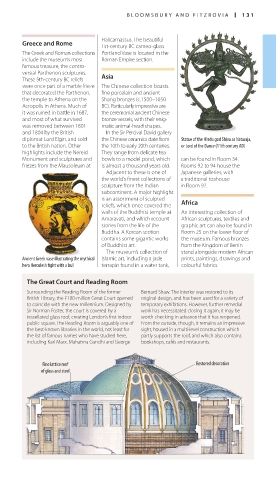
diplomat Lord Elgin, and sold the Chinese ceramics date from Statue of the Hindu god Shiva as Nataraja,
to the British nation. Other the 10th to early 20th centuries. or Lord of the Dance (11th century AD)
highlights include the Nereid They range from delicate tea
Monument and sculptures and bowls to a model pond, which can be found in Room 34.
friezes from the Mausoleum at is almost a thousand years old. Rooms 92 to 94 house the
Adjacent to these is one of Japanese galleries, with
the world’s finest collections of a traditional teahouse
sculpture from the Indian in Room 92.
subcontinent. A major highlight
is an assortment of sculpted
reliefs, which once covered the Africa
walls of the Buddhist temple at An interesting collection of
Amaravati, and which recount African sculptures, textiles and
stories from the life of the graphic art can also be found in
Buddha. A Korean section Room 25 on the lower floor of
contains some gigantic works the museum. Famous bronzes
of Buddhist art. from the Kingdom of Benin
The museum’s collection of stand alongside modern African
Ancient Greek vase illustrating the mythical Islamic art, including a jade prints, paintings, drawings and
hero Hercules’s fight with a bull terrapin found in a water tank, colourful fabrics.
The Great Court and Reading Room
Surrounding the Reading Room of the former Bernard Shaw. The interior was restored to its
British Library, the £100-million Great Court opened original design, and has been used for a variety of
to coincide with the new millennium. Designed by temporary exhibitions. However, further remedial
Sir Norman Foster, the court is covered by a work has necessitated closing it again; it may be
tessellated glass roof, creating London’s first indoor worth checking in advance that it has reopened.
public square. The Reading Room is arguably one of From the outside, though, it remains an impressive
the best-known libraries in the world, not least for sight, housed in a multi-level construction which
the list of famous names who have studied here, partly supports the roof, and which also contains
including Karl Marx, Mahatma Gandhi and George bookshops, cafés and restaurants.
Fine lattice roof Restored decoration
of glass and steel
130-131_EW_London.indd 131 21/03/17 2:20 pm

