


Page 135 - (DK Eyewitness) Travel Guide - London
P. 135
BL OOMSBUR Y AND FITZROVIA 133
6 Foundling A copy of nearly every printed
Museum book in the UK is held here –
more than 14 million – and
40 Brunswick Square WC1. Map 5 C4. can be consulted by those
Tel 020 7841 3600. 1 Russell with a reader’s ticket. There
Square. Open 10am–5pm Tue–Sat, are also exhibition galleries
11am–5pm Sun. Closed 1 Jan, 24–26 open to all. In the Treasures
& 31 Dec. & ^ 7 - = Coram’s
Fields: Guilford St WC1. Open 9am– Gallery, visitors may view some
dusk. ∑ foundlingmuseum.org.uk of the library’s most precious
items, including the Lindisfarne
In 1722, Captain Thomas Coram, Gospels. Other rare volumes
a retired sailor and shipbuilder include a Gutenberg Bible
recently returned from the and Shakespeare’s First Folio.
Americas and horrified by the
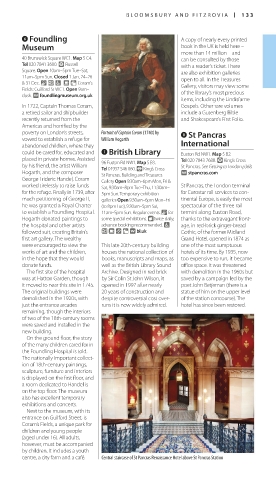
poverty on London’s streets, Portrait of Captain Coram (1740) by 8 St Pancras
vowed to establish a refuge for William Hogarth International
abandoned children, where they
could be cared for, educated and 7 British Library Euston Rd NW1. Map 5 B2.
placed in private homes. Assisted 96 Euston Rd NW1. Map 5 B3. Tel 020 7843 7688. 1 King’s Cross
by his friend, the artist William Tel 01937 546 060. 1 King’s Cross St Pancras. See Getting to London p368.
Hogarth, and the composer St Pancras. Building and Treasures ∑ stpancras.com
George Frideric Handel, Coram Gallery Open 9:30am–6pm Mon, Fri &
worked tirelessly to raise funds Sat, 9:30am–8pm Tue–Thu, 11:30am– St Pancras, the London terminal
for the refuge. Finally in 1739, after 5pm Sun. Temporary exhibition for Eurostar rail services to con-
much petitioning of George II, galleries Open 9:30am–6pm Mon–Fri tinental Europe, is easily the most
he was granted a Royal Charter (to 8pm Tue), 9:30am–5pm Sat, spectacular of the three rail
to establish a Foundling Hospital. 11am–5pm Sun. Regular events. & for termini along Euston Road,
Hogarth donated paintings to some special exhibitions. 8twice daily; thanks to the extravagant front-
the hospital and other artists advance booking recommended. 7 age, in red-brick ginger-bread
followed suit, creating Britain’s ^ - 0 = ∑ bl.uk Gothic, of the former Midland
first art gallery. The wealthy Grand Hotel, opened in 1874 as
were encouraged to view the This late 20th-century building one of the most sumptuous
works of art and the children, houses the national collection of hotels of its time. By 1935, now
in the hope that they would books, manuscripts and maps, as too expensive to run, it became
donate funds. well as the British Library Sound office space. It was threatened
The first site of the hospital Archive. Designed in red brick with demolition in the 1960s but
was at Hatton Garden, though by Sir Colin St John Wilson, it saved by a campaign led by the
it moved to near this site in 1745. opened in 1997 after nearly poet John Betjeman (there is a
The original buildings were 20 years of construction and statue of him on the upper level
demolished in the 1920s, with despite controversial cost over- of the station concourse). The
just the entrance arcades runs it is now widely admired. hotel has since been restored.
remaining, though the interiors
of two of the 18th-century rooms
were saved and installed in the
new building.
On the ground floor, the story
of the many children cared for in
the Foundling Hospital is told.
The nationally important collect-
ion of 18th-century paintings,
sculpture, furniture and interiors
is displayed on the first floor, and
a room dedicated to Handel is
on the top floor. The museum
also has excellent temporary
exhibitions and concerts.
Next to the museum, with its
entrance on Guilford Street, is
Coram’s Fields, a unique park for
children and young people
(aged under 16). All adults,
however, must be accompanied
by children. It includes a youth
centre, a city farm and a café. Central staircase of St Pancras Renaissance Hotel above St Pancras Station
132-133_EW_London.indd 133 21/03/17 2:25 pm

