


Page 186 - (DK Eyewitness) Travel Guide - London
P. 186
184 L ONDON AREA B Y AREA
Exploring Tate Modern A number of the murals
were presented to the Tate
Since its inception in 2000, Tate Modern has eschewed a shorthly before Rothko’s death
traditional, chronological approach in favour of hanging in 1970.
its collections thematically, deliberately juxtaposing On the same floor is Citizens
pieces from different eras and continents. Two floors and States, which looks at the
of the main building, plus exhibition spaces in the ten- way artists explore and engage
with political and social ideas.
storey extension, are used to show displays from the Pablo Picasso’s Weeping Woman
collection, each space exploring the development of (1937) and Kazimir Malevich’s
artistic movements or recurring themes in modern and Dynamic Suprematism (pictured)
contemporary art. Other spaces show temporary exhibitions are examples of some of the
(some with an exhibition charge). The focal point of the works on display; there is a
whole building is the vast Turbine Hall, often entirely room dedicated to the German
artist and activist Joseph Beuys
taken over by a specially commissioned installation. (1921–86).
Works shown on these pages are examples of what might Floor 4, enlarged by 60 per
be on display. cent by the 2016 extension, has
two wings: Material Worlds and
Media Networks. Material
Located on floors 2 and 4 of the Worlds explores the different
The Permanent main building are four exhibition materials and textures used
Collections spaces comprising a series of by artists. The wing features
The collections in Tate Modern rooms. Each space is dedicated Marcel Duchamp’s famous
comprise over 70,000 works to a particular art movement Fountain (a 1964 replica of
of modern art by some of or theme, with various works the 1917 original). One of the
the most significant and well- exploring its origin and impact artist’s so-called “readymades”,
known artists of the 20th and on modern art. Fountain is a urinal purchased
21st century, from Pablo Picasso Making Traces, on floor 2, by Duchamp and designated
to Francis Bacon. The gallery reviews the actions of artists a work of art. Media Networks
continues to acquire new and the marks they make while looks at how artists have
work by artists from across creating works. Mark Rothko’s responded to mass media
the globe and, as a result of Seagram murals (1958–9) are
an ever-expanding collection, at the heart of the exhibition.
displays are regularly rotated. This series of canvasses had
This means that major works originally been commissioned
are not always guaranteed to by the opulent Four Seasons
be on show – always check restaurant, located in the
online before visiting if there Seagram building in New York.
is a particular work you wish The group of paintings,
to see. In general, the best entitled Red on Maroon and
way to explore the gallery is Black on Maroon, are of open,
to take one of the regular free rectangular, window-like forms
guided tours (usually hourly and are sombre in mood.
11am–3pm, check at the Rothko eventually decided to
information desk) or pick up withhold the murals from the
an audioguide. Four Seasons, considering
By and large, the collections the restaurant an inappropriate Section of From the Freud Museum
are displayed thematically. environment for the works. (1991–6) by Susan Hiller
The Transformation of Bankside Power Station
This forbidding fortress was designed in 1947 by Sir Giles
Gilbert Scott, the architect of Battersea Power Station, Waterloo
Bridge and London’s famous red telephone boxes. The power
station is of a steel-framed brick skin construction, comprising
over 4.2 million bricks. The Turbine Hall was designed to
accommodate huge oil-burning generators and three vast oil
tanks are still in situ. The power station itself was con verted by
Swiss architects Herzog and de Meuron who designed the two-
storey glass box, or lightbeam, which runs the length of the
building. This serves to flood the upper galleries with light and
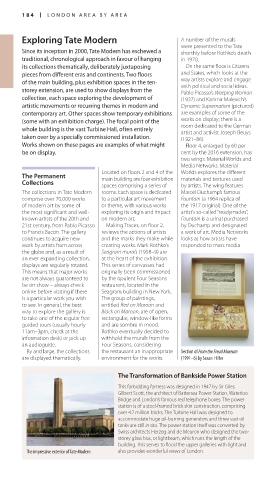
The impressive exterior of Tate Modern also provides wonderful views of London.
184-185_EW_London.indd 184 15/05/2017 15:37

