


Page 192 - (DK Eyewitness) Travel Guide - London
P. 192
190 L ONDON AREA B Y AREA
Street-by-Street: Around the Southbank Centre
Originally this was an area of wharves and factories
which was much damaged by bombing during World
War II. It was chosen as the site of the 1951 Festival of
Britain (see p34), celebrating the centenary of the Great
Exhibition (see pp30–31). The Royal Festival Hall is the
only building from 1951 to remain, but since then
London’s main arts centre has been created around it, UPPER GROUND
including the national showcases for theatre, music
and film, and a major art gallery.
To the Strand
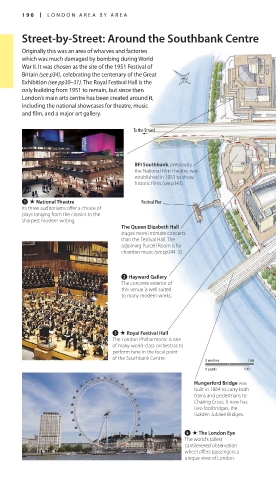
BFI Southbank, previously
the National Film Theatre, was
established in 1953 to show
historic films (see p343).
1 . National Theatre Festival Pier
Its three auditoriums offer a choice of
plays ranging from the classics to the
sharpest modern writing.
The Queen Elizabeth Hall
stages more intimate concerts
than the Festival Hall. The
adjoining Purcell Room is for
chamber music (see pp344–5).
2 Hayward Gallery
The concrete exterior of
this venue is well suited
to many modern works.
3 . Royal Festival Hall
The London Philharmonic is one
of many world-class orchestras to
perform here in the focal point
of the Southbank Centre.
0 metres 100
0 yards 100
Hungerford Bridge was
built in 1864 to carry both
trains and pedestrians to
Charing Cross. It now has
two footbridges, the
Golden Jubilee Bridges.
6 . The London Eye
The world’s tallest
cantilevered observation
wheel offers passengers a
unique view of London.
190-191_EW_London.indd 190 21/03/17 2:21 pm

