


Page 102 - Inventions - A Visual Encyclopedia (DK - Smithsonian)
P. 102
Public transit


          As industrial cities, such as London and Paris, grew
          bigger in the early 19th century, a growing number

          of people lived farther away from their places of work.
          This spurred the growth of public transportation systems.
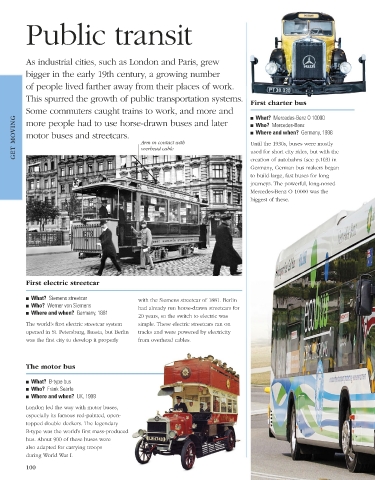
                                                                                   First charter bus
          Some commuters caught trains to work, and more and                       ■ ■ What?  Mercedes-Benz O 10000
      GET MOVING  motor buses and streetcars.    Arm in contact with               ■ ■ Who?  Mercedes-Benz
          more people had to use horse-drawn buses and later
                                                                                    ■ Where and when?  Germany, 1938
                                                                                   ■
                                                                                   Until the 1930s, buses were mostly
                                               overhead cable
                                                                                   used for short city rides, but with the
                                                                                   creation of autobahns (see p.103) in
                                                                                   Germany, German bus makers began
                                                                                   to build large, fast buses for long
                                                                                   journeys. The powerful, long-nosed
                                                                                   Mercedes-Benz O 10000 was the
                                                                                   biggest of these.


          First electric streetcar

          ■ ■ What?  Siemens streetcar        with the Siemens streetcar of 1881. Berlin
          ■ ■ Who?  Werner von Siemens        had already run horse-drawn streetcars for
          ■ ■ Where and when?  Germany, 1881
                                              20 years, so the switch to electric was
          The world’s first electric streetcar system   simple. These electric streetcars ran on
          opened in St. Petersburg, Russia, but Berlin   tracks and were powered by electricity
          was the first city to develop it properly   from overhead cables.


          The motor bus


          ■ ■ What?  B-type bus
          ■ ■ Who?  Frank Searle
          ■ ■ Where and when?  UK, 1909
          London led the way with motor buses,
          especially its famous red-painted, open-
          topped double deckers. The legendary
          B-type was the world’s first mass-produced
          bus. About 900 of these buses were
          also adapted for carrying troops
          during World War I.
          100


   US_100-101_Public_transport_Gallery.indd   100                                                                08/03/18   3:09 PM

