


Page 106 - Inventions - A Visual Encyclopedia (DK - Smithsonian)
P. 106
Sail power                                                                       Model of lateen-
                                                                                           rigged caravel


          Early sailing ships mostly had square sails,
          which worked only with the wind pushing

          from behind. Then, 2,000 years ago, the
          Romans invented triangular sails, which

          came to be called Latin or lateen sails. These
      GET MOVING  sail almost directly into the wind.                           Sturdy, square-sailed ships were fine
          can be set at an angle, allowing a ship to

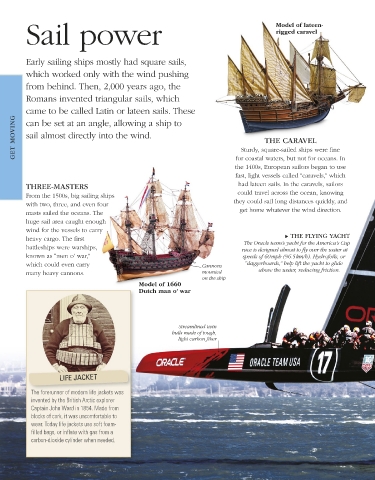
                                                                                       THE CARAVEL


                                                                              for coastal waters, but not for oceans. In
                                                                              the 1400s, European sailors began to use
                                                                              fast, light vessels called “caravels,” which
          THREE-MASTERS                                                        had lateen sails. In the caravels, sailors
          From the 1500s, big sailing ships                                    could travel across the ocean, knowing
          with two, three, and even four                                     they could sail long distances quickly, and
          masts sailed the oceans. The                                         get home whatever the wind direction.
          huge sail area caught enough
          wind for the vessels to carry
          heavy cargo. The first                                                              ▶ THE FLYING YACHT
                                                                                 The Oracle team’s yacht for the America’s Cup
          battleships were warships,                                            race is designed almost to fly over the water at
          known as “men o’ war,”                                                speeds of 60 mph (96.5 km/h). Hydrofoils, or
          which could even carry                                   Cannons       “daggerboards,” help lift the yacht to glide
          many heavy cannons.                                      mounted           above the water, reducing friction.
                                                                   on the ship
                                              Model of 1660
                                              Dutch man o’ war


                                                           Streamlined twin
                                                         hulls made of tough,
                                                           light carbon fiber


                     LIFE JACKET

           The forerunner of modern life jackets was
           invented by the British Arctic explorer
           Captain John Ward in 1854. Made from
           blocks of cork, it was uncomfortable to
           wear. Today life jackets use soft foam-
           filled bags, or inflate with gas from a
           carbon-dioxide cylinder when needed.


   US_104-105_Sail_Power_Main.indd   104                                                                         08/03/18   3:09 PM

